

Four setups separate contractors who know their real margins from contractors guessing at them. Turn on project or job tracking and tag every transaction to a job. Build a contractor chart of accounts that splits cost of goods sold, materials, direct labor, and subcontractors, away from overhead. Pick cash or accrual based on your revenue and how long your typical project runs. Then commit to a weekly rhythm of categorizing transactions and reconciling every bank and credit card account.
Skip any one of these and job costs bleed into overhead, margins look better (or worse) than reality, and you end up pricing your next bid on bad data. Here’s the shortest path to fixing it this week:
- Turn on job tracking now. Every invoice, bill, and expense gets tagged to a specific job, no exceptions.
- Rebuild your chart of accounts. Separate materials, direct labor, and subcontractor costs from rent, insurance, and admin overhead.
- Choose your accounting method deliberately. Cash works for small, short jobs; accrual is usually required once you’re doing multi-month projects or crossing IRS gross receipts thresholds.
- Set a weekly reconciliation habit. Thirty minutes categorizing transactions and matching receipts beats a monthly scramble every time.
Key Takeaways
Accurate job-level bookkeeping, built on job tracking, a contractor chart of accounts, and a weekly reconciliation habit, is what turns bidding from a guess into a repeatable, profitable process.
| Point | Details |
|---|---|
| Tag every job immediately | Turn on Projects and assign every transaction to a job at entry rather than retrospectively. |
| Split your chart of accounts | Separate materials, labor, and subcontractor costs from overhead for clearer job margin insights. |
| Match method to project length | Use cash accounting for smaller contractors and shorter projects; consider accrual accounting for longer projects or larger operations. |
| Document classification and collect W-9s | Apply the IRS common-law test and get W-9s signed before the first subcontractor payment. |
| Outsource at the right threshold | Truemeasureaccounting builds job costing systems and offers fractional CFO support as contractors’ bookkeeping needs grow beyond DIY capacity. |
Table of Contents
- How to set up bookkeeping for contractors: accounts, projects, and method
- What should you do weekly, monthly, and quarterly?
- How do you track job costing, retainage, and WIP accounting?
- How should contractors handle payroll, subcontractors, and 1099s?
- What software actually supports contractor bookkeeping?
- How TrueMeasure implements contractor bookkeeping
- How do you track contractor expenses and receipts without losing them?
- How do you handle subcontractor payments and documentation?
- How should bonding, insurance, and lien waivers show up in your books?
- How do you connect bookkeeping to project management and invoicing tools?
- The one change that returns the most value
- How TrueMeasure helps contractors get their books under control
- Frequently Asked Questions
- Sources
How to set up bookkeeping for contractors: accounts, projects, and method
Most contractor bookkeeping problems trace back to two setup mistakes: the wrong chart of accounts and missing job tags. Fix those two things first, and profit leaks that were invisible for months often show up in your very next report, according to the contractor bookkeeping guide from Build-Folio.
1. Build a contractor-specific chart of accounts. A generic small-business chart of accounts lumps everything into “expenses.” Yours needs a dedicated cost of goods sold section that separates materials, direct labor, subcontractor payments, and equipment rental from your overhead accounts, things like office rent, insurance, and administrative payroll. This split is what lets you calculate gross margin by job instead of guessing at it once a year.
2. Turn on project or job tracking. In QuickBooks Online Plus or Advanced, that means enabling the Projects module and tagging every bill, invoice, expense, and payroll hour to a job. Whoever enters transactions, you, an office manager, or a field supervisor, needs to tag at the point of entry, not after the fact. Retroactive tagging is where job costing dies in most shops.
3. Choose cash or accrual with your revenue and project length in mind. If your jobs close in a few weeks and you’re under roughly $500,000 in revenue, cash accounting is often simpler and defensible, a threshold echoed in PipelineON’s 2026 contractor bookkeeping guidance. Once you’re running multi-month projects with retainage and progress billing, accrual gives you a far more honest picture of what you’ve actually earned versus what you’ve collected.
4. Decide upfront how you’ll record retainage, deposits, and change orders. Set these up as their own line items or sub-accounts before your first invoice goes out, not after your CPA asks where the $40,000 in withheld retainage went.
Pro Tip: Set your job-tagging rule as a hard stop in your invoicing workflow. If a bill can’t be assigned to a job or an overhead category before it’s entered, it doesn’t get entered. That one rule fixes more bad books than any software upgrade.
What should you do weekly, monthly, and quarterly?
Contractor books go stale fast because job costs pile up daily across multiple sites. A cadence built around your revenue and the CFMA’s construction financial benchmarks (the Construction Financial Management Association publishes industry-specific ratios worth tracking) keeps you working from current numbers instead of last quarter’s guesswork.
Weekly (30 to 60 minutes):
- Categorize every bank and credit card transaction and assign it to the correct job.
- Match field receipts and material invoices to the job they belong to.
- Scan accounts receivable for anything over 30 days and follow up.
Monthly:
- Reconcile every bank, credit card, and loan account against statements.
- Run a job profitability report and compare actual margin to what you bid.
- Review overall cash position against upcoming payroll and material commitments.
Quarterly:
- Calculate and pay estimated federal taxes.
- Prepare 1099 tracking for subcontractors paid during the quarter.
- Sit down with a CPA or advisor and review key performance indicators: gross margin by job type, overhead percentage, and revenue per crew.
A simple discipline drives most of this: assigning every transaction to a job weekly, then reviewing a project profitability report monthly, cuts down on the reactive pricing and underbidding that comes from working off stale numbers, per Build-Folio’s contractor bookkeeping research.
Who does this work depends on your size. Under roughly $500,000 in revenue, an owner can often handle weekly and monthly tasks directly if they block out about four hours a week for it. Past that, a part-time or specialty bookkeeper usually earns back their fee in caught errors and recovered time. Above $1.5 million to $2 million, quarterly KPI review starts to warrant a fractional CFO’s eye, not just a bookkeeper’s.
How do you track job costing, retainage, and WIP accounting?
Job costing only works if you’re capturing every cost category that touches a project, and most contractors miss at least one.
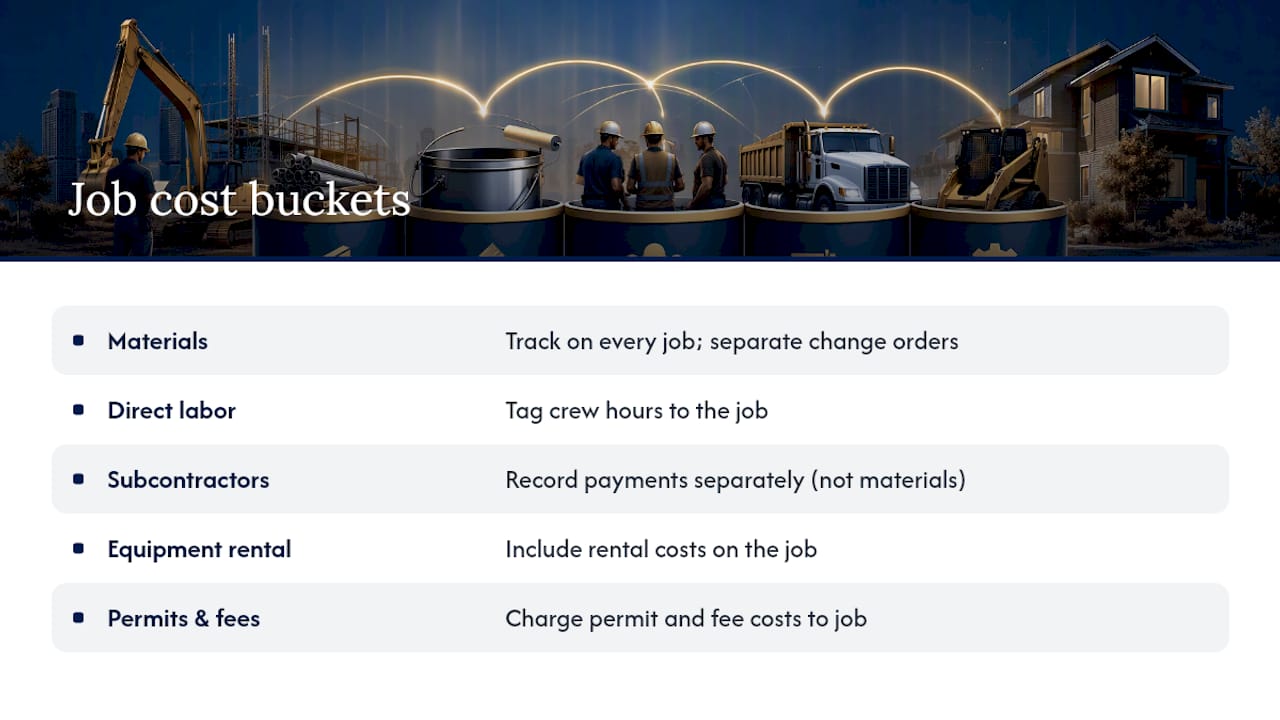
1. Track five cost buckets on every job: materials, direct labor, subcontractor payments, equipment rental, and permits or fees. Change orders need their own line so original bid amounts stay comparable to what actually got built.
2. Post progress invoices and retainage correctly. When you bill a percentage of a contract as work completes, that invoice hits accounts receivable, but the portion your client withholds as retainage (commonly 5 to 10 percent) needs its own receivable sub-account rather than sitting mixed into “AR: general.” That way you can see exactly how much retainage you’re owed across all active jobs at any moment.
3. Run work-in-progress (WIP) reports on active jobs at least monthly. A WIP report compares costs incurred and billings to date against the total contract value, telling you whether you’re over-billed or under-billed on a job before it’s too late to correct pricing on the next draw. QuickBooks’ construction bookkeeping guidance treats job costing and retainage tracking as core, not optional, for any contractor running project-based work. Job costing methods vary by trade and contract type, and a practical breakdown of allocation methods can help you pick the one that fits how your crews actually bill hours.
4. Watch for the errors that mask true margins. The most common: lumping subcontractor payments into “materials,” forgetting to tag owner-paid credit card purchases to a job, and failing to close out completed jobs so old costs keep bleeding into current reports.
Pro Tip: If your gross margin swings more than a few points between your bid and your actual job profitability report, don’t assume the bid was wrong. Check your job tagging first. Nine times out of ten, it’s a coding problem, not a pricing problem.
How should contractors handle payroll, subcontractors, and 1099s?
Worker misclassification is one of the most expensive mistakes a contractor can make, and it’s also one of the easiest to prevent with paperwork you should already be collecting.
The IRS applies a common-law test built around three factors: behavioral control (do you direct how the work gets done), financial control (who provides tools and bears profit or loss risk), and the relationship itself (is there a contract, benefits, an expectation of ongoing work). No single factor decides it. Document all three for every subcontractor relationship, and if you’re genuinely unsure, Form SS-8 lets you request a binding determination from the IRS itself.
- Collect a signed W-9 before the first payment goes out, not after. Chasing tax IDs in January is how 1099 season becomes miserable.
- Turn on 1099 tracking in your accounting software for every vendor flagged as a subcontractor so payments accumulate automatically through the year.
- Watch the January 31 deadline for filing Form 1099-NEC with any subcontractor paid $600 or more during the year; penalties stack per form and per month late.
- Run payroll properly for W-2 employees, since misclassifying an employee as a 1099 contractor can trigger back payroll taxes, penalties, and interest that dwarf whatever you saved in the short term.
Documenting classification factors and getting W-9s signed early cuts down significantly on year-end scrambling and audit exposure, a point the IRS’s own guidance reinforces.
What software actually supports contractor bookkeeping?
The right software stack depends less on brand and more on four features: a projects or jobs module, class or location tracking, automated bank feeds, and some way to get field time and material entries tied to the correct job without manual re-entry.
Field data capture is where most contractors lose job costing accuracy. If a foreman’s hours or a truck’s fuel receipt don’t make it into the system tagged to the right job within a few days, that cost either gets lost or dumped into overhead. Mobile time tracking apps that sync directly to your accounting software close that gap far better than paper timesheets handed in on Friday.
Scale should drive your tech decisions:
- Under $500,000 in revenue: QuickBooks Online Plus with the Projects module enabled is typically enough, provided the owner commits real weekly time to categorization.
- $500,000 to $2 million: Add automated bank rules, class tracking by division or crew, and consider QuickBooks Online Advanced for deeper reporting.
- Above $2 million: Integration between your accounting platform, a dedicated project management tool, and payroll becomes worth the setup cost, since manual reconciliation between systems starts eating hours every week.
Your setup checklist regardless of size: enable Projects, flag every 1099-eligible vendor at entry, and build bank rules for recurring expenses like fuel, insurance, and material suppliers so categorization happens automatically instead of by hand. If configuring this feels like more than your week allows, accounting software setup support can get the structure right the first time.
How TrueMeasure implements contractor bookkeeping
Truemeasureaccounting’s standard contractor onboarding follows a set sequence: QuickBooks cleanup, a rebuilt chart of accounts split by COGS and overhead, Projects module enablement, and a weekly categorization cadence set from day one.
- Faster month-end close, often within days instead of weeks.
- Job profitability reporting accurate enough to price the next bid with confidence.
- Profit leaks identified early, before they compound across a full season of work.
- Clear service-fit guidance: DIY works under roughly $500,000 in revenue, a part-time bookkeeper fits the next tier, and ongoing service plus fractional CFO advisory becomes the higher-ROI move as revenue and job complexity grow.
How do you track contractor expenses and receipts without losing them?
Paper receipts stuffed in a truck console are how job costs disappear. The fix isn’t complicated, but it has to happen at the point of purchase, not at month-end.

Every crew member or supervisor making a job-related purchase should photograph the receipt immediately using your accounting software’s mobile app and tag it to the job on the spot. Waiting even a week means someone’s reconstructing which $340 charge at the supply house belonged to which address, and that reconstruction is rarely accurate.
Set a hard rule: no receipt gets categorized to “uncategorized expense” or sits untagged past the week it was incurred. Credit cards should be dedicated per crew or per project manager where volume justifies it, since a shared card makes job attribution guesswork instead of fact. For recurring vendors, fuel stations, material suppliers, equipment rental companies, automated bank rules can pre-assign a default job or ask for confirmation, cutting manual entry time substantially.
Mileage deserves its own system separate from receipts. Contractors driving between job sites daily should log mileage through a dedicated app rather than reconstructing it from memory at tax time, since the IRS requires contemporaneous records to support that deduction. The combination of point-of-purchase tagging and a dedicated mileage log is what turns receipt tracking from a monthly headache into a five-minute weekly review.
How do you handle subcontractor payments and documentation?
Subcontractor payments carry more paperwork risk than almost any other contractor expense category, because a missing document today becomes a 1099 problem, a lien problem, or a classification problem later.
Before a subcontractor’s first invoice gets paid, you need three documents on file: a signed W-9, a certificate of insurance showing active general liability coverage, and a signed subcontractor agreement outlining scope and payment terms. Skipping the certificate of insurance is a common shortcut that turns expensive fast if that sub gets injured on your job site with no coverage in place.
Every subcontractor payment should be tagged to the specific job it supports, coded to your subcontractor cost account (never blended into “materials”), and matched against an invoice that references a specific scope of work or draw schedule. For larger draws tied to project milestones, request a lien waiver at the time of payment, more on that below, since collecting it later means chasing a subcontractor who’s already moved on to another job.
Keep a running subcontractor ledger separate from your general vendor list. It should show total paid year-to-date per subcontractor, which feeds directly into your 1099 tracking, and which jobs each payment applied to, which feeds directly into job costing. When these two views live in the same record, reconciling subcontractor costs against job profitability at month-end takes minutes instead of an afternoon of cross-referencing spreadsheets.
How should bonding, insurance, and lien waivers show up in your books?
Bonding costs, insurance premiums, and lien waivers rarely get proper bookkeeping treatment, and that gap creates real cash flow blind spots.
Bond premiums for a specific project should be coded as a direct job cost, not general overhead, since they’re tied to winning and executing that contract. General liability and workers’ compensation premiums typically split differently: the portion allocable to active jobs can be tracked as job cost, while base coverage often sits in overhead. Talk through this split with whoever prepares your job costing reports so it’s applied consistently across every project, not decided fresh each time.
Lien waivers are a documentation task, not a bookkeeping entry, but they belong in the same system as your payment records. Before releasing payment, especially final payment, to a subcontractor or before your client releases a progress payment to you, a conditional or unconditional lien waiver should be collected and attached to that specific job’s file. Missing a lien waiver on a completed job is one of the most common reasons contractors get pulled into payment disputes months after the work is finished, long after anyone remembers the details.
Build a simple rule: no final payment goes out, and no final invoice gets marked paid, until the corresponding lien waiver is on file. That single checkpoint, tied directly to your accounts payable and accounts receivable workflow, prevents most of the lien and bonding headaches that surface during audits or disputes.
How do you connect bookkeeping to project management and invoicing tools?
Contractors who run separate systems for project management, invoicing, and bookkeeping usually end up re-entering the same data three times, and each re-entry is a chance for a job cost to land in the wrong place or disappear entirely.
The fix is integration, not more manual double-checking. When your project management tool, the one tracking schedules, change orders, and field time, syncs directly with your accounting software, labor hours and change order approvals flow into job costing without anyone retyping them. Look for a two-way sync where invoices generated in your project management or estimating tool post directly to accounts receivable in your accounting system, tagged to the correct job automatically.
The Construction Financial Management Association and construction-focused ERP providers consistently point to project-level financial visibility as what separates contractors who scale profitably from those who don’t, since project management data without a bookkeeping connection tells you what happened on site, not what it cost you. If your current invoicing process runs through a separate app from your accounting software, check whether it supports a native or third-party integration before you build another manual workaround. Support setting this integration up correctly the first time is available through dedicated software configuration help, which matters more than most contractors expect until they’ve spent a season reconciling three disconnected systems by hand.
The one change that returns the most value
If you take nothing else from this article, take this: tag every transaction to a job the week it happens, then read one report every month, your job profitability report by project.
That single habit is what exposes the underbid job before you repeat the same pricing mistake on the next one. Contractors who adopt weekly job tagging and a monthly profitability review typically recover the cost of the habit in the very first month, usually through one job they stop underpricing once they see the real numbers.
Once you cross roughly $500,000 in revenue, or your job count and subcontractor payments get complex enough that weekly tagging eats more than a few hours, that’s the point to bring in specialty bookkeeping. It’s not a sign you failed at running your own books. It’s a sign your business outgrew the version of bookkeeping that got you here.
How TrueMeasure helps contractors get their books under control
If you’ve read this far and recognized your own books in the mistakes described, chances are the fix isn’t more DIY effort, it’s the right setup done once, correctly.
Truemeasureaccounting works directly with HVAC companies, plumbing contractors, electricians, and general contractors to solve exactly the problems this article covers: a chart of accounts that doesn’t separate job costs from overhead, missing job tags, and books too stale to price the next bid with confidence. A typical engagement starts with a QuickBooks cleanup and chart of accounts rebuild, then moves into Projects module setup and a weekly categorization cadence, the same sequence outlined above, done for you instead of squeezed into your Friday afternoons.
Deliverables are concrete: monthly job profitability reports, a cash flow forecast you can actually plan around, and KPI dashboards that show margin by job type instead of one blended number at year-end. Contractors under roughly $500,000 in revenue often start with a cleanup project alone; larger operations typically move into ongoing monthly bookkeeping, and past $1.5 million to $2 million, fractional CFO advisory adds the strategic layer that a bookkeeper alone can’t provide.
If your job costing has been a guessing game for too long, talk to Truemeasureaccounting about contractor bookkeeping services and get a system built around how your business actually runs.
Frequently Asked Questions
What’s the difference between bookkeeping for contractors and standard small-business bookkeeping?
Standard bookkeeping tracks total revenue and expenses. Contractor bookkeeping tracks cost and profitability by individual job, requiring job tagging, retainage tracking, and a chart of accounts split between direct job costs and overhead.
When should a contractor switch from cash to accrual accounting?
Once projects routinely run longer than a few months or involve retainage and progress billing, accrual accounting gives a far more accurate picture of earned revenue than cash accounting can, even if cash still worked fine for shorter jobs.
At what revenue level should a contractor hire a bookkeeper instead of doing it themselves?
DIY bookkeeping with software like QuickBooks Online Plus is defensible under roughly $500,000 in revenue if the owner commits several hours weekly. Beyond that, specialty bookkeeping services typically deliver a better return than owner time spent on data entry.
What documents should a contractor collect before paying a subcontractor?
A signed W-9, a certificate of insurance, and a signed subcontractor agreement should all be on file before the first payment. A lien waiver should follow at the time of each significant payment, especially the final one.
How does job costing improve pricing on future bids?
Job costing shows exactly where a completed project’s actual costs diverged from the original estimate, materials running over, labor hours underestimated, so the next bid for similar work reflects reality instead of last year’s assumptions.
Sources
- How to Do Bookkeeping for Construction Companies
- Independent contractor (self-employed) or employee?
- Contractor Bookkeeping: The Complete Guide (2026)
- 2026 Contractor Bookkeeping: Essential Tips and Insights