
A working bookkeeping checklist keeps your books current, protects your cash flow, and turns tax season into a non-event instead of a scramble. The core idea is simple: break every bookkeeping task into a cadence, daily, weekly, monthly, quarterly, and year-end, and assign each one an owner and a time estimate.
Here’s the cadence at a glance:
- Daily: Record sales, capture receipts, log deposits.
- Weekly: Categorize expenses, chase overdue invoices, schedule payments.
- Monthly: Reconcile accounts, generate P&L and cash flow reports.
- Quarterly: Pay estimated taxes, file payroll taxes, review the budget against actuals.
- Year-end: Close the books, issue W-2s and 1099s, prepare your tax package.
Owners who run this cadence consistently rarely face a surprise at tax time, because nothing gets buried for eleven months. Pull the checklist into a spreadsheet or your accounting software today, assign the first week’s tasks to someone by name, and start the daily habit tomorrow morning.
Key Takeaways
A frequency-based bookkeeping checklist, daily, weekly, monthly, quarterly, year-end, keeps books accurate enough to drive pricing, cash flow, and tax decisions instead of just satisfying compliance.
| Point | Details |
|---|---|
| Assign a named owner | Every task needs a specific person’s name attached, not just a role, or it gets skipped. |
| Reconcile monthly, without exception | Monthly reconciliation catches errors while they’re a five-minute fix, not a year-end restatement. |
| Tag jobs and customers | Job-level tagging turns your P&L into a profitability tool that shows which work is worth repeating. |
| Prioritize by deadline and cash impact | Payroll and sales tax deadlines come first, then reconciliation, then receivables, then routine categorization. |
| Outsource when the backlog wins | Truemeasureaccounting offers monthly bookkeeping, QuickBooks cleanup, and fractional CFO support once DIY bookkeeping starts costing more time than it saves. |
Table of Contents
- What a Bookkeeping Checklist Covers and Who Should Own Each Task
- Daily and Weekly Bookkeeping Tasks You Can’t Afford to Skip
- The Monthly Close: The Bookkeeping Task You Can’t Skip
- Quarterly and Year-End Bookkeeping: What to File and When
- How Reconciliation Actually Works (and Where the Errors Hide)
- Tools and Templates That Make the Checklist Stick
- How to Roll Out Your Bookkeeping Checklist in 5 Steps
- How to Prioritize When Bookkeeping Tasks Pile Up
- Adapting the Checklist to Your Business Size and Industry
- Common Bookkeeping Pitfalls That Quietly Cost Money
- Author Perspective: Bookkeeping Is a Decision Tool, Not Just a Compliance Chore
- Outsourcing Your Bookkeeping: How TrueMeasure Accounting Helps
- Frequently Asked Questions
- Sources
What a Bookkeeping Checklist Covers and Who Should Own Each Task
Bookkeeping is the recording of every transaction your business makes. Accounting is what you do with that data, tax strategy, profitability analysis, cash flow forecasting. A checklist exists to make sure the raw material (bookkeeping) is accurate enough that the higher-level work (accounting) actually means something.
A complete checklist spans seven areas: transaction capture, bank and credit card reconciliation, accounts receivable and payable, payroll, tax reporting, job costing, and financial reporting. Skip job costing and you’re flying blind on which projects actually make money. This matters enormously for contractors and service businesses, where one underpriced job can wipe out the margin on three profitable ones.
Ownership determines whether a checklist survives contact with a busy week. Assign each task to a specific person, not a department:
- Owner/operator: Approves large payments, reviews weekly cash position, sets pricing.
- Bookkeeper (internal or outsourced): Daily transaction entry, weekly categorization, monthly reconciliation.
- External payroll provider: Payroll runs, tax deposits, W-2/1099 filing.
- CPA or tax preparer: Quarterly estimated payments guidance, year-end tax return.
Pro Tip: Write the owner’s name directly on the checklist line, not just the role. “Bookkeeper” is vague enough that tasks slip through the cracks; “Maria, every Tuesday” doesn’t.
Not every task carries equal weight. Bank reconciliation and payroll tax deposits are critical, miss them and you risk penalties or a distorted cash position. Categorizing minor expenses can slide a day or two without real damage.
Daily and Weekly Bookkeeping Tasks You Can’t Afford to Skip
Daily bookkeeping isn’t about perfection. It’s about capturing information while it’s fresh, before a receipt gets lost in a truck console or a customer payment gets mixed in with twelve others.
Daily tasks (10-15 minutes total):
- Record the day’s sales and invoices issued.
- Photograph or file receipts for cash purchases and fuel.
- Log bank and merchant deposits against your sales records.
- Count petty cash if your business handles it.
- Scan your bank balance for anything unusual, a bounced check, a duplicate charge, an unexpected withdrawal.
Weekly tasks (30-45 minutes total):
- Enter and categorize the week’s bills and expenses.
- Reconcile merchant processor deposits against actual sales, card processors often batch and delay deposits, which can hide a shortfall if you’re not checking.
- Update your accounts receivable aging and follow up on anything more than 15 days overdue.
- Schedule vendor payments so you’re not paying early and starving cash flow, or paying late and losing vendor goodwill.
- Review job costs against estimates for any projects wrapping up that week.
The SBA’s guidance on managing business finances emphasizes that consistent recordkeeping is one of the most reliable predictors of a small business staying solvent through a rough quarter.
Pro Tip: If your daily bookkeeping is regularly taking more than 30 minutes, that’s a signal, not a badge of thoroughness. It usually means transactions are piling up uncategorized. At that point, it’s often cheaper to bring in catch-up bookkeeping help than to keep losing an hour a day to a backlog.
The Monthly Close: The Bookkeeping Task You Can’t Skip
The monthly close is where your numbers stop being a guess and start being usable. Skip it for two or three months and you lose the ability to trust anything the reports tell you.
Here’s the sequence, in order:
- Reconcile every bank and credit card account against statements, line by line.
- Match merchant processor deposits to the sales they represent, checking for fee discrepancies.
- Review uncategorized transactions and assign them to the correct account or job.
- Post recurring journal entries, depreciation, loan interest accruals, prepaid expense amortization.
- Reconcile payroll liabilities to confirm withheld taxes match what was actually remitted.
Once that’s done, three reports come out the other end:
- Profit & loss statement: Shows whether the business made money that month, and on what.
- Balance sheet: Shows what you own, what you owe, and your equity position at a point in time.
- Cash flow statement: Shows where cash actually moved, which can look very different from the P&L if you invoice on terms.
For a solo owner doing this manually, expect three to five hours a month. A trained bookkeeper working from clean bank feeds usually finishes the same close in one to two hours, because they’re not relearning the chart of accounts each time. QuickBooks recommends treating monthly reconciliation as the point where you “prove” your numbers, catching an error in month three is a five-minute fix; catching it in month eleven means restating a year of reports.
Pro Tip: Set up bank rules that auto-categorize recurring vendors, fuel, insurance, subscriptions. It won’t eliminate review, but it can cut your categorization time by more than half.
Quarterly and Year-End Bookkeeping: What to File and When
Quarterly tasks exist because the IRS doesn’t wait until April to collect. If your business pays estimated taxes, IRS guidance on estimated taxes lays out the payment schedule you need to build your quarterly checklist around.
Quarterly checklist:
- Calculate and pay estimated federal (and state, where applicable) taxes.
- File payroll tax returns (Form 941 and state equivalents).
- File and remit sales tax returns if you collect it.
- Compare quarterly P&L against your budget or forecast, not just against last quarter.
- Review any loan covenants tied to financial ratios, missing a covenant check can trigger a technical default even when the business is healthy.
Year-end is where quarterly discipline pays off or where its absence turns into a two-week fire drill. A phased year-end approach that reconciles as you go produces a far cleaner handoff to your CPA than a single December scramble.
Year-end checklist, in rough order:
- Reconcile every bank, credit card, and loan account through December 31.
- Issue W-2s to employees and 1099s to contractors.
- Count physical inventory if you carry it, and adjust the books to match.
- Review fixed assets for depreciation and disposals.
- Prepare a final trial balance and full set of financial statements.
- Archive records per your retention policy.
Start the reconciliation portion in early November, not January. Next Insurance’s year-end guidance recommends spreading these tasks across the last quarter rather than compressing them into the first two weeks of the new year. Delegate W-2/1099 prep to your payroll provider early; most have a hard internal deadline in mid-January to guarantee on-time filing, and missing it means penalties that have nothing to do with your actual tax liability. For a deeper look at the tax-specific side of this work, see our year-end tax planning checklist.
How Reconciliation Actually Works (and Where the Errors Hide)
Reconciliation isn’t glamorous, but it’s the single task that determines whether every other number in your books can be trusted.
The process, done right, looks like this: gather your source documents (bank and credit card statements, merchant processor reports), match every line to a corresponding ledger entry, flag exceptions, post the adjusting entries needed to explain any remaining difference, then lock the period so nothing can be backdated into it.
Certain accounts cause trouble more often than others. Uncategorized transactions pile up in a holding account and quietly distort your P&L if left there. Uncleared checks make your book balance look higher than your real available cash. Merchant-fee mismatches happen when a $500 sale deposits as $485.50 and the $14.50 gets miscoded instead of booked as a processing expense. Payroll liability accounts drift when the amount withheld doesn’t match what actually got remitted to the state.
Clean bookkeeping feeds three numbers every owner in a service business should watch monthly: gross margin by job, because it tells you which projects and which crews are actually profitable, not just busy. Days sales outstanding (DSO), because a rising DSO is often the earliest warning sign of a cash crunch, weeks before it shows up in your bank balance. Cash runway, because it answers the one question that keeps owners up at night: how many months can this business survive if revenue stalled today?

Pro Tip: Tag every invoice and expense with a job or customer code, not just an account. It’s a small habit that turns your P&L into a job-costing tool and often exposes the one client or project quietly draining your margin. Our breakdown of bookkeeping’s role in profitability goes deeper on how to build this into your chart of accounts.
Tools and Templates That Make the Checklist Stick
Software matters less than consistency, but the right platform removes friction. QuickBooks Online fits most service businesses that need job costing and integrations with payroll and payment processors. Xero tends to suit businesses with a leaner chart of accounts and multiple currencies or entities. FreshBooks works well for solo operators and small teams whose bookkeeping is mostly invoicing and expense tracking rather than complex job costing. A side-by-side look at FreshBooks and QuickBooks can help narrow the choice if you’re still deciding.
| Business Type | Likely Best Fit | Why |
|---|---|---|
| Solo contractor or freelancer | FreshBooks | Simple invoicing, minimal job costing needed |
| Multi-crew service business | QuickBooks Online | Job costing, payroll integration, industry apps |
| Multi-entity or investor-owned | Xero | Cleaner multi-entity handling |
Whatever software you pick, build your checklist as a template with three columns: Owner, Due Date, Done. That structure alone forces accountability that a mental checklist never will.
- Turn on bank feeds so transactions import automatically instead of manual entry.
- Set recurring transactions for rent, insurance, and loan payments.
- Build categorization rules for your top ten vendors.
- Automate invoice reminders at 7, 15, and 30 days overdue.
- Back up financial data separately from your accounting software and limit who has edit access. Most tax authorities expect records retained for several years, so archive rather than delete.
How to Roll Out Your Bookkeeping Checklist in 5 Steps
- Pick your cadence and tool. Choose the software that matches your business complexity and commit to the daily/weekly/monthly rhythm above.
- Map your source documents. List every bank account, credit card, payment processor, and payroll system feeding into your books.
- Assign owners. Put a name, not a role, next to every recurring task.
- Run your first monthly close. Treat month one as a dry run. Expect it to take longer than month three.
- Add automation and handoff rules. Once the manual process works, layer in bank rules and recurring entries, then document how work gets handed off if your bookkeeper is out.
Pro Tip: If step three keeps failing because no one on your team has the bandwidth, that’s the signal to move from DIY to outsourced bookkeeping. A proper cleanup and catch-up engagement typically starts by reconstructing a few months of clean records before handing you a checklist you can actually sustain.
How to Prioritize When Bookkeeping Tasks Pile Up
Every owner falls behind eventually. A slow season turns into a busy one, and suddenly three weeks of receipts sit unfiled. The mistake most owners make is treating every overdue task as equally urgent. It isn’t.
Rank overdue work by financial consequence, not by how long it’s been sitting there. Payroll tax deposits and sales tax remittances go first, these carry penalties and interest that compound the longer they wait. Bank reconciliation comes next, because an unreconciled account means you genuinely don’t know your cash position, and every decision you make until it’s fixed is a guess. Accounts receivable follow-up ranks third: every week an invoice sits unpaid past 30 days, the odds of collecting it in full drop.
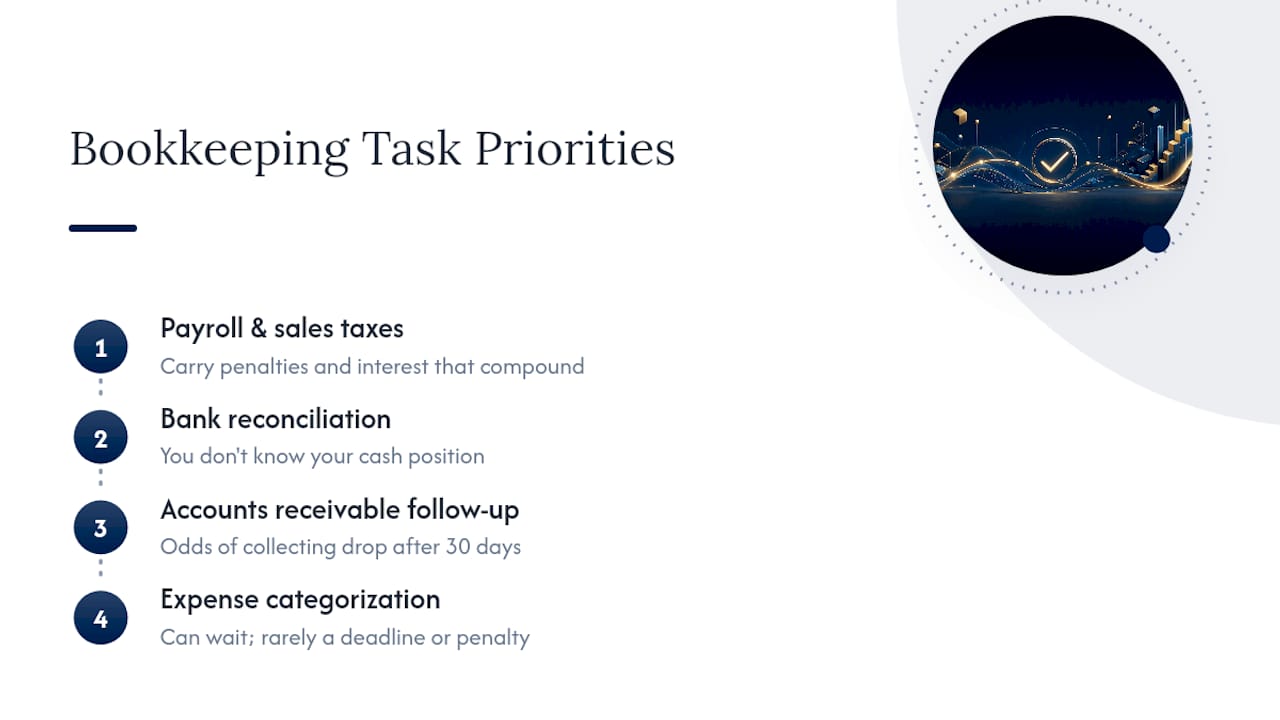
Categorizing routine expenses and filing minor receipts can wait. They matter for accuracy, but they rarely carry a deadline or a penalty attached.
A practical rule: work backward from anything with a government deadline attached, then from anything affecting your cash position, then from anything affecting your reported profitability. Expense categorization for internal reporting purposes sits at the bottom of that list every time.
If the backlog is more than a month deep, resist the urge to catch up by working faster on old data. Speed leads to miscoded transactions, and miscoded transactions create bigger problems than the ones you started with. It’s usually faster, and cheaper in the long run, to have someone reconstruct the backlog methodically than to rush it yourself between customer calls.
Adapting the Checklist to Your Business Size and Industry
The cadence stays the same across business sizes. What changes is who does the work and how much detail each task needs.
A solo HVAC technician running $300,000 a year can realistically handle daily and weekly tasks personally, spending 20 minutes each evening on receipts and invoices, then hand the monthly close to a part-time bookkeeper or an outsourced firm. A 15-person electrical contracting company generating $2 million needs someone dedicated to daily entry, because the volume of receipts, subcontractor invoices, and material purchases makes a 15-minute daily task closer to an hour.
Industry shapes which parts of the checklist carry the most weight. Trucking and transportation businesses need tight daily fuel and mileage tracking, because fuel is often the single largest variable cost and the easiest one to lose track of across multiple trucks. Construction and general contracting businesses need job costing built into every weekly review, not just monthly, because change orders and material overruns can erode a project’s margin in a matter of days if no one’s watching. Real estate investors need a checklist that separates each property or entity, commingling accounts across properties is one of the fastest ways to lose the ability to tell which asset is actually performing. Property management companies need trust accounting handled separately from operating accounts, an area where compliance rules are strict and unforgiving.
The fix isn’t a different checklist for each industry. It’s the same frequency-based structure with different emphasis, more time on fuel logs for trucking, more time on job costing for contractors, stricter account separation for real estate.
Common Bookkeeping Pitfalls That Quietly Cost Money
Most bookkeeping problems aren’t dramatic. They’re small habits that compound over months until the books no longer reflect reality.
Mixing personal and business expenses through the same account is the most common one, and it makes every other number unreliable because you’re constantly guessing what belongs where. Letting uncategorized transactions accumulate is a close second; a “miscellaneous” bucket that grows every month is really just a P&L that’s lying to you by omission.
Reconciling infrequently causes damage that’s easy to underestimate. An error made in March and caught in December means restating nine months of reports, and it means every decision made in between, pricing, hiring, purchasing, was based on numbers that were already wrong. Ignoring job-level or project-level tagging is another quiet cost: without it, your P&L tells you the business made money, but it can’t tell you which jobs made it and which jobs lost it, and that’s the exact insight that should drive your pricing.
Relying on a single person with no documented process is a structural risk more than a bookkeeping error, but it shows up in the books first. If that person leaves, gets sick, or simply gets buried, the checklist stops running and nobody notices until a bill goes unpaid or a tax deadline passes. Our look at common bookkeeping errors walks through several of these in more detail, including how small miscoding habits show up as a distorted margin months later.
The fix for nearly all of these is the same: a written checklist, an assigned owner, and a monthly reconciliation that actually happens instead of getting pushed to “next week.”
Author Perspective: Bookkeeping Is a Decision Tool, Not Just a Compliance Chore
Most owners think of bookkeeping as the thing you do so the IRS doesn’t come knocking. That view costs them money. Clean, current books tell you which jobs to bid on again, which customers to fire, and whether a slow month is a cash timing issue or a real problem.,
Outsourcing Your Bookkeeping: How TrueMeasure Accounting Helps
Running this checklist yourself works, until growth, a busy season, or a hiring gap makes it unsustainable. Truemeasureaccounting exists for the point where you need more than basic data entry but you’re not ready for a full-time controller. We handle monthly bookkeeping and reconciliations, QuickBooks cleanup and catch-up projects, job costing and profitability analysis, and fractional CFO advisory work built around how your business actually operates.
We work primarily with:
- HVAC, plumbing, and electrical contractors
- General contractors and construction companies
- Trucking and transportation businesses
- Real estate investors and property managers
The benefit isn’t just tidier books. It’s knowing your cash position without guessing, seeing which jobs actually make money, and walking into tax season with a finished package instead of a scramble. If your checklist has been slipping for a few months, our bookkeeping services page outlines how a cleanup and ongoing monthly engagement typically starts.
Frequently Asked Questions
What should a basic bookkeeping checklist include?
A basic checklist covers daily transaction recording, weekly invoice and bill review, monthly bank reconciliation and reporting, quarterly tax filings, and year-end closing tasks like W-2s and a final trial balance.
How long does monthly bookkeeping actually take?
For a solo owner doing it manually, expect three to five hours a month. A trained bookkeeper working from clean, automated bank feeds typically finishes the same close in one to two hours.
What’s the difference between a bookkeeping checklist for freelancers and one for a larger service business?
The cadence is identical, but a freelancer can usually handle daily and weekly tasks personally in under 20 minutes, while a multi-crew business needs a dedicated person and tighter job-costing detail each week.
When should a business move from DIY bookkeeping to outsourcing?
Once monthly reconciliation starts slipping past 30 days, or the backlog of uncategorized transactions keeps growing instead of shrinking, it’s usually more cost-effective to bring in outside help than to keep losing owner hours to it.
Sources
- Manage your finances – U.S. Small Business Administration
- Estimated Taxes – IRS
- Year-end checklist for small businesses: 15 steps | QuickBooks
- Year-end bookkeeping checklist — Next Insurance