
Financial clarity is the ability to see every dollar flowing into and out of your business, recognize the patterns inside those flows, and make confident decisions based on what the numbers actually say. For a service business owner running HVAC calls, plumbing jobs, construction projects, or trucking routes, that clarity is the difference between pricing work profitably and guessing, between making payroll with confidence and sweating it every other Friday.
Before you read another word, do this 60-second check. Can you state your current business bank balance right now? Can you say how many months of expenses that balance covers? Can you name your total revenue for the past 30 days? If any of those three numbers require a login, a call to your bookkeeper, or a rough estimate, you have a clarity gap. The good news: it is fixable, and most owners see a meaningful shift within 30 days of putting the right system in place. Full financial clarity is typically reached within 90 days when following a simple, repeatable review structure.
Table of Contents
- How financial clarity differs from budgeting and financial transparency
- The four building blocks every service business needs first
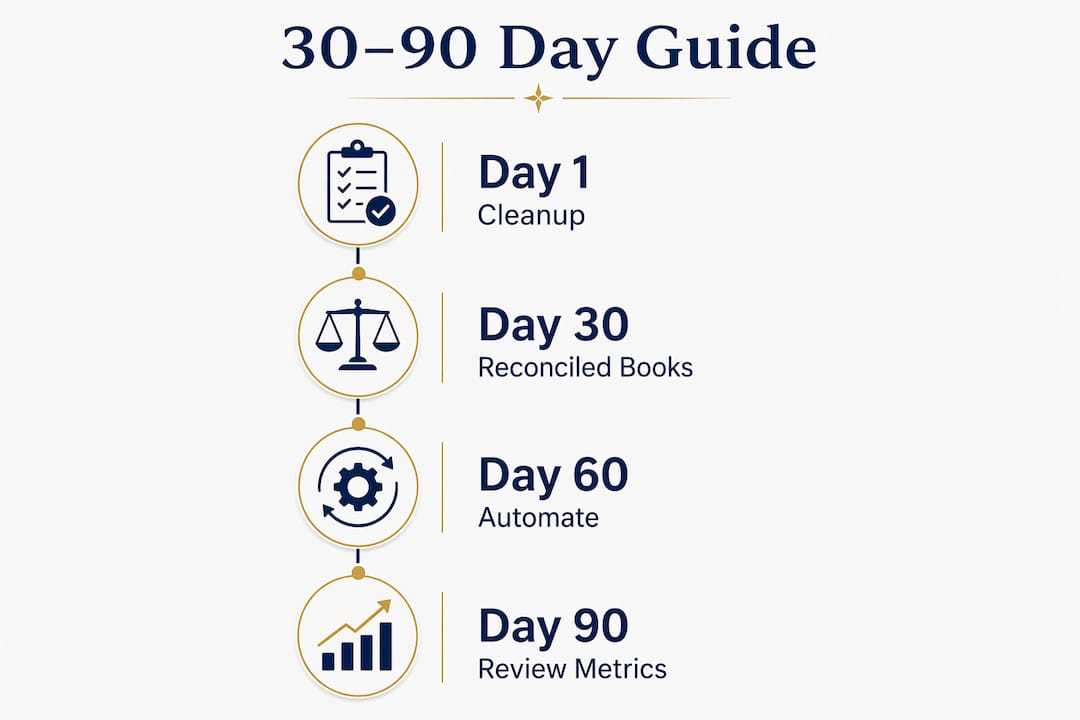
- A step-by-step checklist to reach financial clarity in 30–90 days
- Who does what and which tools actually help
- What does financial clarity actually cost, and how fast does it pay off?
- The KPIs and dashboards that prove you have financial clarity
- Common mistakes that destroy clarity and the red flags to fix immediately
- How Truemeasureaccounting delivers financial clarity: method, proof, and what you get
- Key Takeaways
- What operators get wrong about financial clarity
- Truemeasureaccounting can get you to financial clarity faster
- Useful sources and next reads
How financial clarity differs from budgeting and financial transparency
These three terms get used interchangeably, and that confusion costs owners real time and money.
Financial clarity is an internal management practice. It is total visibility into your company’s financial state: every inflow and outflow, the patterns inside those flows, and how they connect to your business decisions. It answers the question: “What is actually happening with my money right now?”
Budgeting is a planning tool. You set revenue and expense targets at the start of a period and compare actuals against them. The problem is that budgets often fail in service businesses because revenue arrives in lump sums tied to project completions, and variable job expenses shift constantly. A budget built in January looks nothing like February’s reality after a slow week and two large material orders.
Financial transparency is about external sharing. It follows standards like GAAP or SEC rules and is designed to build trust with outside stakeholders such as lenders, investors, or partners. Transparency requires timeliness, accuracy, consistency, and clear communication. It matters enormously when you are seeking a line of credit or bringing on a business partner, but it is not a substitute for the internal clarity you need to run daily operations.
The real distinction: Budgeting tells you where you planned to go. Transparency tells the outside world where you have been. Clarity tells you where you actually are, right now, so you can decide what to do next.
Inside a service firm, the people who benefit most from clarity are the owner (pricing and hiring decisions), the dispatcher or project manager (job profitability), and whoever handles payroll (cash timing). SCORE and SBA research consistently points to poor cash flow understanding as a major driver behind many small business failures. That statistic is not about bad budgets. It is about owners who could not see what was happening until it was too late.
QuickBooks Online is the most common accounting platform for service businesses in this revenue range, and it provides the data layer that makes clarity possible. But software alone does not create clarity. Truemeasureaccounting pairs QuickBooks with a structured review process and a chart of accounts built around how your business actually operates.
The four building blocks every service business needs first
Before you can achieve full money management visibility, four structural elements need to be in place. Think of them as the foundation. Without all four, your numbers will mislead you.
-
Clean books with daily transaction capture. Every job payment, material purchase, subcontractor invoice, and fuel receipt gets recorded and categorized the day it happens or the next morning. For an HVAC company running 15 service calls a day, a one-week lag in data entry means you are making dispatch and pricing decisions on stale information.
-
A chart of accounts tied to your operations. Generic accounting categories like “Other Expenses” tell you nothing. Your chart of accounts should answer the questions you actually ask: What did labor cost on residential installs versus commercial? What is my gross margin on service agreements versus new equipment sales? A plumbing company with separate income lines for drain cleaning, water heater installs, and emergency calls can spot which service line is carrying the others.
-
Reconciled reports on a regular cadence. Reconciliation means your bank statement and your QuickBooks balance match, every month, without exception. Unreconciled books are the single most common reason owners distrust their own numbers. When you can trust the report, you can act on it.
-
Cash flow planning with allocation buckets. Knowing your balance is not the same as knowing your runway. Allocating cash into buckets (payroll, materials, owner pay, taxes, operating reserve) before you spend it is what separates owners who make payroll easily from those who scramble. This is especially critical in construction and contracting, where a large draw can make the bank balance look healthy while three subcontractor invoices are due in five days.
KPIs tied to each building block
| Building Block | Key Metric | Why It Matters |
|---|---|---|
| Clean books | Days since last reconciliation | Unreconciled books hide errors and fraud |
| Chart of accounts | Gross margin by job or service line | Reveals which work is actually profitable |
| Reconciled reporting | Accounts receivable aging (30/60/90 days) | Flags slow-paying customers before cash runs short |
| Cash flow allocation | Cash days on hand | Shows how many days you can operate without new revenue |
Quick-check questions for each block:
- Can you pull a profit and loss report right now that you trust?
- Does your chart of accounts have a separate line for each major service or job type?
- Is your last bank reconciliation less than 30 days old?
- Do you have a written plan for how this month’s deposits will be allocated before they are spent?
If any answer is no, that block is your starting point. Improving financial visibility at the building-block level is where the fastest gains come from.
A step-by-step checklist to reach financial clarity in 30–90 days
This is a runnable timeline. Assign each step to a role and hold that person accountable for the deadline.
Days 1–7: Capture and assess
- Pull your last three months of bank and credit card statements. (Owner)
- Log into QuickBooks Online and identify uncategorized transactions. (Owner or bookkeeper)
- List every recurring subscription and vendor payment. (Owner)
- Identify the last date your books were reconciled. (Bookkeeper)
- Write down your three quick-check numbers: bank balance, cash runway, last 30 days of revenue. (Owner)
Days 8–30: Clean up and categorize
- Rebuild or review your chart of accounts so it maps to your actual services and job types. (Bookkeeper or accountant)
- Categorize all uncategorized transactions back at least 90 days. (Bookkeeper)
- Reconcile all bank and credit card accounts through the current month. (Bookkeeper)
- Separate any personal expenses that ran through the business account. (Owner and bookkeeper)
- Set up bank feeds in QuickBooks Online so new transactions import automatically. (Bookkeeper)
Months 2–3: Automate, report, and review
- Create a simple weekly cash flow snapshot (income received, bills due, projected balance). (Bookkeeper or fractional CFO)
- Build a KPI dashboard with at least four metrics: gross margin by job, AR aging, cash days on hand, payroll as a percentage of revenue. (Accountant or fractional CFO)
- Schedule a 15-minute weekly money review every Monday morning. (Owner)
- Set up automated invoice reminders for outstanding receivables. (Bookkeeper)
- Review your first fully reconciled monthly report and identify two decisions it supports. (Owner and fractional CFO)
Pro Tip: The cleanup step that unlocks the most value fastest is reconciling your bank accounts and separating personal from business expenses. Do those two things first, and every other report becomes trustworthy. Everything else builds on that foundation.
What to expect at 30 days: Reconciled books, a clean chart of accounts, and your first accurate profit and loss report. You will know which months were profitable and which were not.

What to expect at 90 days: A working KPI dashboard, a weekly review habit, and enough pattern data to make one confident pricing or hiring decision you could not have made before. Most owners report a meaningful shift in confidence within 30 days of starting a weekly review, and full clarity within 90 days.
Who does what and which tools actually help
Getting clear on roles prevents the most common mistake: the owner doing everything and doing none of it consistently.
The four roles and when you need each one
- Bookkeeper: Records transactions, reconciles accounts, manages AR and AP, and produces monthly reports. You need one the moment your transaction volume makes weekly data entry a burden, typically above $250,000 in annual revenue.
- Accountant: Reviews financial statements, handles tax preparation, advises on entity structure, and catches errors the bookkeeper may miss. Most service businesses need an accountant at minimum for quarterly reviews and year-end filing.
- Tax preparer/tax strategist: Prepares returns and, more importantly, plans proactively to reduce liability. A reactive tax preparer costs you money. A proactive tax strategist saves it. See how professional service firms reduce taxes with the right approach.
- Fractional CFO: Interprets financial data in the context of business decisions: pricing, hiring, equipment purchases, expansion. You need fractional CFO support when your books are clean but you still cannot answer questions like “Can I afford to add a second crew?” or “Which customer segment is actually profitable?”
Signs you need to add a role now
- You have not seen a reconciled profit and loss report in more than 60 days.
- You are not sure whether your most recent quarter was profitable.
- You missed a tax payment or received a notice from the IRS.
- Payroll has felt uncertain at least once in the past six months.
- You are making pricing decisions based on gut feel rather than job cost data.
Tools to standardize on
QuickBooks Online is the right baseline for most service businesses in the $250,000–$5 million range. Bank feeds pull transactions automatically, class tracking lets you separate job types, and the reporting suite covers the basics without requiring a finance degree to navigate. Pair it with an automated invoicing tool and a simple dashboard, and you have the data infrastructure clarity requires.
Software alone does not create clarity, though. The platform is only as useful as the review cadence and the chart of accounts behind it. A weekly 15-minute review in QuickBooks beats a monthly three-hour scramble every time.
Screening questions when hiring a bookkeeper or fractional CFO:
- Have you worked with HVAC, plumbing, construction, or trucking companies before?
- How do you handle job costing in QuickBooks?
- What does your monthly close process look like, and what do you deliver at the end of it?
- How do you flag cash flow problems before they become emergencies?
What does financial clarity actually cost, and how fast does it pay off?
Owners often delay getting help because they are not sure what it costs or whether the return justifies it. Here are realistic ranges for U.S. service businesses generating $250,000–$5 million annually.
| Service | Typical Monthly Cost | Time to First Impact |
|---|---|---|
| Monthly bookkeeping (ongoing) | — | 30 days (first reconciled report) |
| QuickBooks cleanup/catch-up project | — | 2–4 weeks |
| Monthly accounting and reporting | — | 30–60 days |
| Fractional CFO/advisory (ongoing) | — | 60–90 days |
These are ballpark ranges. Actual pricing depends on transaction volume, how far behind the books are, and the complexity of your job costing needs.
What owners typically see at each milestone
- 4 weeks: Reconciled books, a trustworthy profit and loss statement, and clarity on which months were profitable.
- 8 weeks: AR aging report showing exactly who owes what, a cash flow projection for the next 30 days, and at least one pricing or billing correction identified.
- 3 months: A working KPI dashboard, a weekly review habit, and enough data to make a confident decision about hiring, equipment, or service pricing.
When DIY is fine and when to hire
DIY is reasonable if:
- Your revenue is below $250,000 and transactions are simple.
- You have fewer than 50 transactions per month.
- Your books are current and reconciled.
- You have time to spend two to three hours per week on financial management.
Hire a professional when:
- You have not reconciled your books in more than 60 days.
- You are mixing personal and business expenses.
- You cannot answer the three quick-check questions from the opening of this article.
- You have received a tax notice or missed a quarterly payment.
- You are making hiring or pricing decisions without reliable job cost data.
The bookkeeping and profitability connection is direct: owners who invest in clean books consistently identify profit leaks they did not know existed.
The KPIs and dashboards that prove you have financial clarity
A dashboard is only useful if it shows the right numbers at the right frequency. Here are the core metrics every service business owner should track.
Weekly snapshot (review every Monday, 15 minutes):
- Current bank balance and projected balance in 14 days. This is your early warning system for cash shortfalls.
- Outstanding AR by age (current, 30, 60, 90+ days). Any invoice over 45 days needs a phone call that week.
- Jobs invoiced but not yet collected. Unbilled work is invisible revenue loss.
Monthly trend panels (review within five days of month-end):
- Gross profit per job or service line. This is the metric that tells you whether your pricing is working. An HVAC company that tracks gross margin separately for service calls, maintenance agreements, and new equipment installs will almost always find one line subsidizing another.
- Payroll as a percentage of revenue. For most service businesses, this should stay within a defined band. When it creeps up, it signals either a revenue drop or a staffing inefficiency. Employee profitability tracking at the individual or crew level makes this metric actionable.
- Cash days on hand. Divide your current cash balance by your average daily operating expenses. Below 15 days is a red flag. Above 45 days gives you room to make strategic decisions.
- Owner pay as a percentage of revenue. If you are not paying yourself consistently, your business is not financially healthy regardless of what the profit and loss says.
- Billing realization rate. For project-based businesses, this is the percentage of estimated hours or costs that actually get billed. A realization rate below 85% usually means scope creep, unbilled change orders, or invoicing delays.
Setting thresholds:
- Green: metric within your target range.
- Yellow: metric 10–15% outside target; review and identify cause.
- Red: metric more than 15% outside target or trending wrong for two consecutive months; take corrective action this week.
Review weekly metrics every Monday. Review monthly metrics within five business days of month-end. The owner should own the weekly review. The fractional CFO or accountant should own the monthly review and present two to three decisions it supports.
Common mistakes that destroy clarity and the red flags to fix immediately
Most clarity problems trace back to a small number of recurring errors. Here is what to watch for and what to do about each one.
Top pitfalls and immediate remediation:
- Messy or generic chart of accounts. Fix: Have your bookkeeper rebuild the chart of accounts this week to match your actual service lines and job types. This single change makes every future report more useful.
- Delayed reconciliations. Fix: Reconcile every bank and credit card account through the current month before doing anything else. Set a recurring calendar reminder for the 5th of each month.
- Mixing personal and business expenses. Fix: Open a dedicated business checking account and business credit card if you have not already. Move all business transactions to those accounts immediately.
- No job costing. Fix: Add class or job tracking in QuickBooks Online and assign every income and direct expense to a job or service type going forward. You cannot price work correctly without this data.
- Unmanaged subscriptions and recurring charges. Fix: Pull your last two months of bank and credit card statements and highlight every recurring charge. Cancel anything you cannot immediately name a business purpose for.
- Invoicing delays. Fix: Invoice on the day the job is complete, not at the end of the week. Every day of delay is a day of free financing you are giving your customer.
Pro Tip: The fastest way to find hidden cash in a service business is to pull your AR aging report and call every customer with an invoice over 45 days. Most of those invoices get paid within a week of a direct conversation. That is not a collections problem. It is a follow-up process problem.
Red flags that mean you should hire a professional this week:
- You have missed a payroll or come close to missing one.
- You have received a notice from the IRS or your state tax authority.
- Your bank account has bounced a check or come close to it.
- You cannot produce a profit and loss report for the past 90 days.
- You are not sure whether your business made money last quarter.
A note on data security: As you improve your financial systems, make sure access to QuickBooks and your banking portals is limited to people who need it. Use role-based permissions in QuickBooks Online so your bookkeeper can enter and reconcile transactions without having transfer authority over your bank accounts. This is basic operational hygiene, not paranoia.
How Truemeasureaccounting delivers financial clarity: method, proof, and what you get
Truemeasureaccounting was built by an operator, not a traditional accountant. Founder Anthony Boncimino spent more than 20 years building and running multi-million-dollar service businesses before starting the firm. That background shapes every engagement: the focus is on what the numbers mean for your decisions, not just whether they are technically correct.
The Truemeasureaccounting method: Monthly bookkeeping and reconciliation → reconciled financial reports → KPI dashboard tied to your operations → cash flow plan with allocation guidance → ongoing advisory cadence where the numbers drive real business decisions.
The firm works with service businesses generating $250,000–$5 million annually: HVAC companies, plumbing contractors, electrical contractors, general contractors, trucking and transportation businesses, real estate investors, property managers, and professional service firms. These are businesses that need more than data entry but are not yet ready for a full-time CFO.
What a client receives:
- A QuickBooks cleanup or catch-up project to establish a clean baseline.
- Monthly bookkeeping and bank reconciliations.
- A KPI dashboard built around their specific service lines and job types.
- Cash flow planning and allocation guidance.
- Proactive tax strategy, not just year-end preparation.
- Fractional CFO advisory: pricing decisions, hiring analysis, profitability by customer or job, and growth planning.
A representative outcome: A home services contractor with $1.2 million in annual revenue came in with 14 months of unreconciled books, no job costing, and no reliable profit and loss. Within six weeks, the books were clean, a job-level gross margin report was running, and the owner identified one service line that was consistently losing money on labor. Pricing on that line was adjusted. Within 90 days, overall gross margin improved and the owner made payroll without stress for the first time in two years.
Choosing your path:
- DIY checklist: Use the 30–90 day checklist above if your books are less than 60 days behind and you have time to manage the process yourself.
- Cleanup project: Start here if your books are more than 60 days behind, you have mixed personal and business expenses, or you have never had a reconciled report you trusted.
- Retained advisory: The right choice when you want clean books, a monthly reporting package, and a strategic partner who helps you act on the numbers every month.
Key Takeaways
Financial clarity requires four building blocks, a weekly review habit, and the right roles in place. Owners who build this system typically see their first meaningful shift within 30 days.
| Point | Details |
|---|---|
| Start with the three numbers | Know your bank balance, cash runway, and last 30 days of revenue before anything else. |
| Build the four blocks first | Clean books, operational chart of accounts, reconciled reports, and cash allocation buckets are non-negotiable. |
| 30 days to first shift | Most owners see meaningful clarity within 30 days of starting a weekly review cadence, and full clarity within 90 days. |
| Hire when red flags appear | Missed payroll, IRS notices, or no reconciled report in 60+ days mean it is time to bring in a professional. |
| Truemeasureaccounting as your partner | Truemeasureaccounting delivers cleanup, monthly bookkeeping, KPI dashboards, and fractional CFO advisory for service businesses generating $250,000–$5 million annually. |
What operators get wrong about financial clarity
Most owners think getting clear on their finances means spending more time on accounting. That framing is exactly backwards, and it is why so many clarity efforts stall after the first month.
The goal is not to understand accounting. The goal is to spend less time worrying about money because the system handles the visibility for you. When your books are clean, your chart of accounts maps to your actual work, and you have a 15-minute Monday review locked into your calendar, you stop making decisions from anxiety and start making them from data.
The owners I have seen struggle most are not the ones who lack discipline. They are the ones who try to do everything themselves for too long. A plumbing company owner running six trucks should not be the one reconciling bank accounts at 10 PM on Sunday. That time has a real cost: decisions delayed, pricing not reviewed, cash flow not planned. The moment you hand that work to someone who does it faster and better, you get time back and you get better information.
The other mistake worth naming: treating a cleanup project as the finish line. Getting your books current is the starting block, not the destination. The value comes from what you do with clean data every week afterward. A reconciled profit and loss report sitting in QuickBooks that nobody reviews is just a more organized version of confusion.
Start with the three numbers. Build the four blocks. Review every Monday. And when the red flags show up, do not wait.
Truemeasureaccounting can get you to financial clarity faster
Most service business owners already know their books need work. The gap is not awareness. It is having a clear path from messy to managed, and a partner who understands what it actually takes to run an HVAC company, a plumbing operation, or a trucking fleet.
Truemeasureaccounting offers a direct route: a cleanup project to establish a clean baseline, monthly bookkeeping services that keep your books current and reconciled, a KPI dashboard built around your service lines, and fractional CFO advisory when you are ready to use the numbers to grow. The engagement starts with a conversation about where your books are today and what decisions you need to make in the next 90 days.
If cash flow planning is the immediate priority, the cash flow forecast guide is a practical next step. If you are ready to talk about your specific situation, reach out through the contact page and the first conversation is straightforward: no jargon, no pressure, just a clear picture of what it would take to get your numbers working for you.
Useful sources and next reads
Research and reference sources used in this article:
- What Is Financial Clarity (and Why Business Owners Need It More Than a Budget) — The anchor definition of financial clarity and the four-pillar framework; useful for owners who want to understand the conceptual foundation before building their system.
- What Is Financial Transparency (and Why Does It Matter in Business)? — Rasmussen University’s clear breakdown of transparency as an external practice; helpful for owners who want to understand the difference between internal clarity and stakeholder-facing reporting.
- Understanding Transparency in Finance: Definition, Importance, and Examples — Investopedia’s overview of financial transparency standards (GAAP, IFRS) and why they matter when seeking outside capital or partnerships.
- Financial Reporting Transparency — Academic research on how reporting transparency reduces cost of capital; relevant for owners considering outside investment or bank financing.
Truemeasureaccounting resources for your next steps:
- Improve Financial Visibility for Your Small Business — Practical tactics for making your books and cash flow visible and useful day to day.
- The Role of Bookkeeping in Profitability for Small Businesses — How accurate books connect directly to profit outcomes; a good read before starting a cleanup project.
- How to Create a Cash Flow Forecast for Small Business — Step-by-step guidance on building a cash flow projection you can actually use for payroll and planning decisions.
- Employee Profitability Tracking for Service Business Owners — How to measure profitability at the crew or employee level; directly relevant to the KPI dashboard section above.
- Why Small Business Owners Need a Financial Advisor — A clear case for when advisory support pays for itself, with context specific to owner-operated businesses.