

Most healthcare practice owners avoid their financials for three overlapping reasons: emotional resistance to money conversations, a genuine lack of time, and accounting systems that were never set up to give useful information. The good news is that none of these are permanent. The single most useful thing you can do today is pull three numbers: your current cash runway in days, your accounts receivable (A/R) days outstanding, and your net collections rate. Those three figures will tell you more about your practice’s financial health in ten minutes than a year of glancing at your bank balance.
Do that, and within 30–90 days you can expect to:
- Know exactly how much cash your practice has and how long it will last
- Identify uncollected revenue sitting in your A/R that you’ve already earned
- Stop making staffing and pricing decisions based on guesswork
- Reduce the anxiety that comes from financial uncertainty
Key Takeaways
Healthcare practice owners avoid financials because of emotional resistance, time scarcity, skills gaps, and broken systems — and each of those barriers has a practical fix that pays for itself within 90 days.
| Point | Details |
|---|---|
| Avoidance has a real cost | Ignoring financials leads to cash flow crises, missed revenue, and tax surprises that compound over time. |
| Three metrics change everything | Cash runway, A/R days, and net collections rate give a small practice more useful data than most owners currently have. |
| Role clarity matters | Bookkeeper, CPA, and fractional CFO serve different functions; most practices only have the first and need all three. |
| 90 days is enough to turn it around | A structured cleanup, an over-the-counter collections process, and a monthly KPI review produce measurable results within one quarter. |
| Truemeasureaccounting | Offers bookkeeping, QuickBooks cleanup, financial reporting, and fractional CFO services built specifically for owner-operated practices. |
Table of Contents
- 1. Why healthcare business owners avoid financials — the real root causes
- 2. What ignoring your finances actually costs the practice
- 3. Common myths practice owners use to justify avoiding the books
- 4. A practical 90-day plan to start engaging with your financials
- 5. Tools and services that make financial management easier for healthcare practices
- 6. How to choose a bookkeeping or advisory partner without getting burned
- 7. A real-world example of what operator-focused accounting fixes
- Running a practice doesn’t excuse avoiding the books
- Truemeasureaccounting works with healthcare practices that are ready to get clear
- Sources
1. Why healthcare business owners avoid financials — the real root causes
The avoidance is rarely about laziness. Financial clarity is a leadership tool, yet clinicians and practice owners repeatedly defer financial engagement because of a deeply ingrained discomfort with money conversations, a phenomenon sometimes called the “money taboo” in practitioner circles. You spent years training to diagnose and treat. The books felt like someone else’s job.
Emotional barriers run deeper than most owners admit. Identity fusion is common: if you define yourself as a clinician, financial management feels like a distraction from your real work rather than part of it. Add the fear of discovering bad news — a negative margin, a tax liability, a cash shortfall — and avoidance becomes a coping mechanism. Physician founders face distinct burnout and identity-related barriers that make administrative and financial tasks especially aversive, compounding the problem over time.
Operational barriers are just as real. A typical small practice owner is seeing patients, managing staff, handling prior authorizations, and chasing payer denials. There are simply not enough hours. When bookkeeping systems are absent or broken, the financial data that does exist is unreliable, so even owners who want to engage can’t trust what they’re looking at.
Skills and role confusion create a third layer. Many owners conflate three distinct functions: bookkeeping (recording what happened), tax compliance (filing accurately), and strategic financial management (using data to make decisions). Understanding the distinct roles of bookkeeper, CPA, and CFO is the starting point for fixing the gap. Most practices have only the first, which means they have historical records but no forward-looking guidance.
Systems and data barriers close the loop. Healthcare finance teams frequently face inadequate internal resources, outdated systems, and data access problems that prevent finance from playing a strategic role. Fragmented revenue-cycle processes, slow A/R, and payer rules that change regularly make the numbers harder to interpret even when they’re available. Evolving reimbursement methodologies and updated accounting standards add another layer of complexity that discourages owners from engaging without professional help.
2. What ignoring your finances actually costs the practice
Avoidance is not neutral. It has a price, and that price compounds.
Cash flow crises are the most immediate consequence. Practice owners frequently mistake their bank balance for a real-time indicator of business health. The bank balance reflects what has already been collected, not what you’ve earned. A practice with $180,000 in outstanding A/R and a 60-day collection lag can look healthy on Monday and face a payroll shortfall on Friday. That gap is entirely preventable with basic cash runway tracking.
Missed revenue accumulates quietly. Denial rates, undercoded visits, and uncollected patient balances are all revenue you’ve already earned but haven’t captured. Payer mix shifts and rising costs strain financial performance and require more proactive finance functions to catch these leaks before they become permanent write-offs.
The operational costs are just as damaging:
- Pricing services without margin data means you may be losing money on your highest-volume service lines
- Hiring decisions made without payroll-to-revenue ratios often result in overstaffing before cash supports it
- Tax surprises arrive because no one tracked estimated liability through the year
- Compliance risk grows when coding and billing records don’t reconcile with financial statements
Owner-operated practices can be busy without being profitable. Payer mix, no-show rates, and weak job costing can erode margins despite a full schedule. The practice looks productive from the outside while the owner wonders why there’s never enough cash. That disconnect is the direct result of avoiding the bookkeeping and profitability analysis that would make the problem visible.
If you recognize any of these patterns, the signs your business needs better accounting are already present.
3. Common myths practice owners use to justify avoiding the books
Myth: “I’m not a numbers person.”
This is the most common and the least defensible. You run diagnostic tests, interpret lab values, and adjust treatment protocols based on data. Financial management uses the same logic: measure, interpret, adjust. The skill gap is real, but it’s learnable — and you don’t have to learn it alone.
Myth: “We’re too small for monthly financial reports.”
A practice billing $400,000 a year has enough cash flow complexity to benefit from monthly reporting. The relevant question isn’t size; it’s whether you’re making decisions without data. Three KPIs — cash runway, A/R days, and net margin per visit — give a small practice more useful information than a 40-page report gives a hospital system.
Myth: “Outsourcing is unaffordable.”
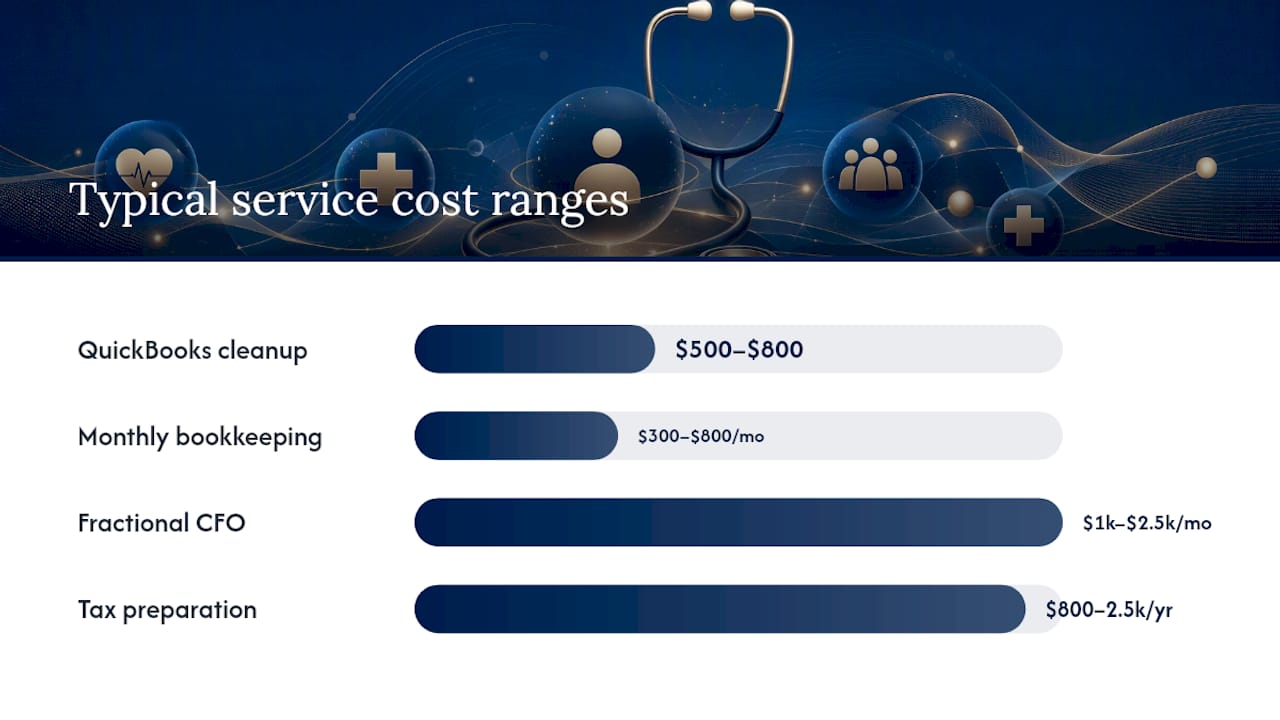
Monthly bookkeeping for a small practice typically runs $300–$800 per month depending on transaction volume and complexity. A fractional CFO engagement often starts around $1,000–$2,500 per month. Compare that to the cost of a single missed denial appeal, a late tax payment, or a pricing decision made without margin data.
Myth: “The accountant handles it at tax time.”
Tax preparation is backward-looking. It records what happened. Strategic financial management is forward-looking. It shapes what happens next. Waiting until April to look at last year’s numbers means you’ve already made twelve months of decisions without guidance.
Pro Tip: Reframe financial review the same way you frame a clinical protocol: test, measure, adjust. Pull three KPIs at the start of each month, note what changed, and decide one thing you’ll do differently. That’s a financial management habit, and it takes less than 30 minutes.
4. A practical 90-day plan to start engaging with your financials
Getting started doesn’t require a full accounting overhaul. It requires a sequence.
Days 1–30: Triage and stabilize
- Pull your last three months of bank and merchant account statements and reconcile them. If QuickBooks is in use, verify that every transaction is categorized.
- Run an A/R aging report. Identify every balance over 60 days and flag it for follow-up or denial appeal.
- Establish an over-the-counter collections process. Collect copays and patient balances at the point of service, every visit. This single change reduces A/R exposure faster than any billing software upgrade.
- Calculate your cash runway: current cash balance divided by average monthly operating expenses. If it’s under 60 days, that’s your first priority.
Days 31–60: Clean up and categorize
- Fix your QuickBooks chart of accounts. Miscategorized expenses distort every report you run.
- Separate personal and business transactions if they’ve been mixed.
- Identify your top three service lines by revenue. Calculate the direct cost of each to get a rough margin.
- Set up a simple monthly KPI dashboard tracking: cash runway, A/R days, net collections rate, payroll as a percentage of revenue, and net margin per visit.
Days 61–90: Build the habit and get help
- Schedule a recurring 60-minute monthly financial review. Put it on the calendar before anything else.
- Decide whether your current bookkeeper (if you have one) is giving you categorized, reconciled data or just transaction entry. If it’s the latter, that’s a gap.
- Evaluate whether you need a fractional CFO for quarterly advisory or whether clean monthly reports are enough for now.
- Use your first clean quarter of data to revisit pricing on your lowest-margin service lines.
Ballpark cost ranges for getting this done:
| Service | Typical Range | What You Get |
|---|---|---|
| QuickBooks cleanup (catch-up) | $500–$800 | Reconciled books, corrected chart of accounts, usable reports |
| Monthly bookkeeping | $300–$800/month | Categorized transactions, monthly P&L, bank reconciliation |
| Fractional CFO | $1,000–$2,500/month | KPI dashboards, cash flow forecasting, advisory on pricing and hiring |
| Tax preparation (small practice) | $800–$2,500/year | Accurate filing, basic year-end planning |
A cash flow forecast built on clean books turns these numbers into a planning tool rather than a rearview mirror.
5. Tools and services that make financial management easier for healthcare practices
When software is enough — and when it isn’t
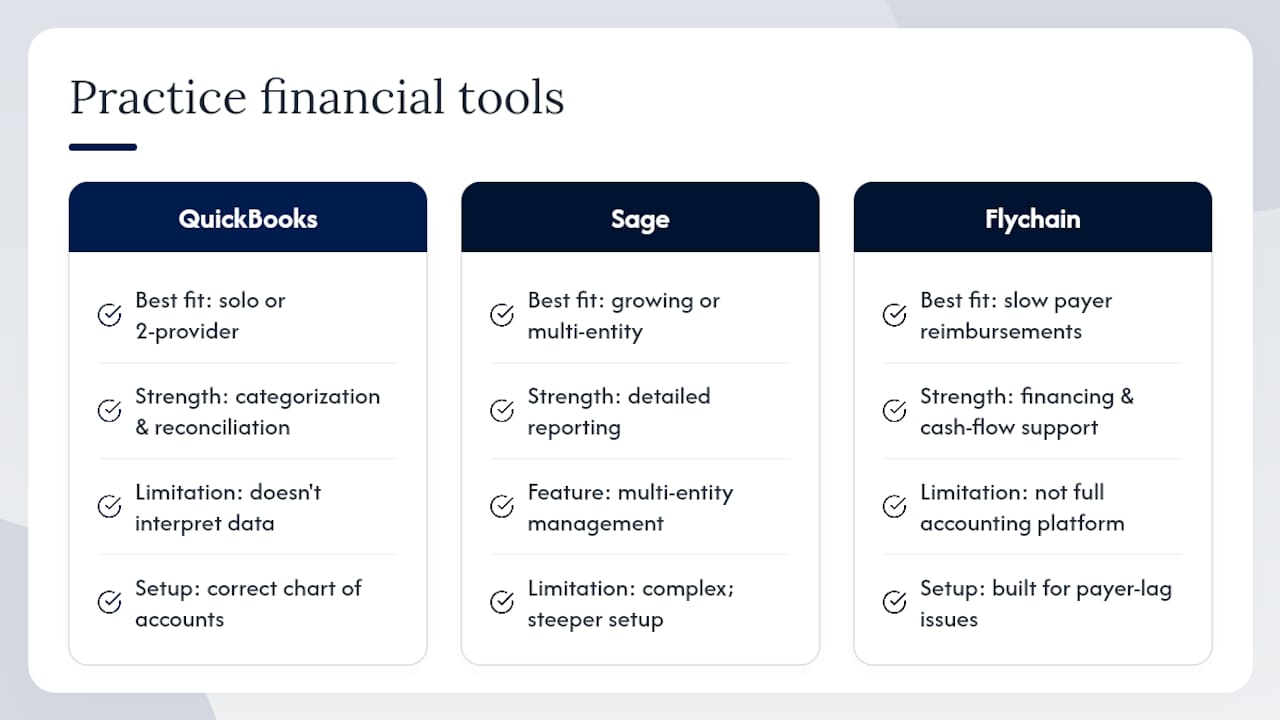
For a solo practice or a two-provider group with straightforward payer contracts, QuickBooks Online handles categorization, bank reconciliation, and basic reporting well. The limitation is that software records transactions; it doesn’t interpret them. A practice with multiple payers, a mix of fee-for-service and value-based contracts, and patient balance collections needs a human to connect the financial data to operational decisions.
QuickBooks remains the most widely used small-business accounting platform in the U.S. For healthcare practices, its value depends entirely on setup quality. A misconfigured chart of accounts produces reports that look complete but are useless for margin analysis. A proper setup with service-line classes and payer-specific income accounts gives you the data to make real decisions.
Sage offers accounting and financial management tools suited to practices that have outgrown QuickBooks’ reporting capabilities or need more granular cost tracking. Its strength is in more detailed financial reporting and multi-entity management, which matters when a practice owner also holds a real estate entity or manages multiple locations.
Flychain is built specifically for healthcare providers, with a focus on revenue cycle financing and cash flow management for practices that deal with slow payer reimbursements. It addresses the specific problem of the lag between service delivery and cash receipt, which is one of the most common cash flow stressors in healthcare.
Pro Tip: Before buying any software, map your revenue cycle on paper: how many payers, what payment timelines, how patient balances are collected. The right tool is the one that fits your actual workflow, not the one with the most features.
Integration priorities for healthcare practices: claims submission, patient payment processing, payer remit reconciliation, and merchant account feeds into your accounting platform. A one-off integration that requires manual exports and imports every month creates more work than it saves and introduces categorization errors.
6. How to choose a bookkeeping or advisory partner without getting burned
The wrong bookkeeper costs more than no bookkeeper. Here’s how to vet providers before you sign anything.
Pre-screen checklist:
- Do they have current healthcare clients? Ask for two references from practices similar in size and payer mix to yours.
- What accounting software do they use, and can they show you a sample monthly deliverable?
- Do they reconcile bank accounts and merchant accounts every month, or just categorize transactions?
- Can they explain the difference between cash-basis and accrual-basis reporting and which is appropriate for your practice?
Interview questions that reveal process quality:
- “Walk me through what you do when a transaction doesn’t match the bank statement.”
- “How do you handle payer remittances that don’t match the billed amount?”
- “What does your monthly close process look like, and when do I receive reports?”
- “What KPIs do you track for healthcare clients, and how do you present them?”
Red flags to walk away from:
- No defined reconciliation schedule or a vague answer about when books are closed each month
- Surprise fees for catch-up work that wasn’t scoped upfront
- No service level agreement on cleanup project timelines
- Reluctance to show sample reports before you sign
- A bookkeeper who has never worked with a healthcare practice and doesn’t ask about your payer mix
In-house vs. outsource vs. fractional CFO: A practice under $500,000 in annual revenue typically gets the most value from outsourced bookkeeping plus annual tax preparation. Between $500,000 and $2 million, adding quarterly fractional CFO advisory pays for itself in pricing and hiring decisions alone. Above $2 million, a part-time controller or dedicated fractional CFO with monthly advisory becomes the right structure.
Start with a short-term pilot. Ask any provider to do a one-month cleanup project before committing to a retainer. The quality of that deliverable tells you everything about their process. Truemeasureaccounting’s financial reporting services are structured exactly this way: clean the data first, then build the advisory layer on top.
7. A real-world example of what operator-focused accounting fixes
Here’s a composite picture drawn from the pattern Truemeasureaccounting sees repeatedly in healthcare practices.
The situation: A physical therapy practice billing roughly $650,000 per year. The owner checked the bank balance each morning to decide whether to approve purchases. A/R days were sitting at 74. Patient balances over 90 days represented about $28,000 in uncollected revenue. QuickBooks had not been reconciled in seven months, and the chart of accounts mixed personal and business expenses.
What was done:
- Reconciled six months of bank and merchant statements, correcting $14,000 in miscategorized transactions
- Rebuilt the chart of accounts with service-line classes (evaluation, treatment, group therapy) to enable margin analysis by service type
- Implemented an over-the-counter collections process: staff collected copays and outstanding balances at check-in, not check-out
- Ran a payer-aging cleanup, re-billing $11,000 in denied claims that were still within the appeal window
- Built a five-KPI monthly dashboard: cash runway, A/R days, net collections rate, payroll ratio, and net margin per visit
Results within 90 days:
- A/R days dropped significantly over the 90 days
- Monthly cash position improved by approximately $9,000 from the combination of collected patient balances and recovered denials
- The owner identified that group therapy sessions carried a higher margin than individual evaluations and adjusted scheduling accordingly
Financial clarity doesn’t require a finance degree. It requires clean data, three to five metrics you check every month, and the discipline to act on what you see. The practice above wasn’t failing — it was flying blind. The numbers were always there. Nobody had organized them into a usable form.
The financial reporting process that produced those results is repeatable in any practice willing to start with a cleanup.
Running a practice doesn’t excuse avoiding the books
There’s a version of this conversation I’ve had with owners across every service industry, and healthcare is no different. The clinical skill is extraordinary. The financial avoidance is understandable. But the two aren’t in conflict.
What I’ve seen consistently is that the owners who engage with their financials don’t become accountants. They become better operators. They make pricing decisions with margin data instead of gut feel. They hire when the payroll ratio supports it. They stop confusing a full schedule with a profitable practice.
Financial clarity is a leadership responsibility. Not a technicality to hand off and forget, and not something to address only when the bank account gets uncomfortable. The numbers are a diagnostic tool, the same way lab results are. You wouldn’t treat a patient without looking at the data. Your practice deserves the same standard.
Pick one metric today. Calculate your A/R days. Write it down. That’s the start.
Truemeasureaccounting works with healthcare practices that are ready to get clear
Healthcare practice owners who are generating revenue but still feel financially uncertain need more than a bookkeeper who enters transactions. They need someone who understands how payer mix, collections timing, and service-line margins connect to the cash they actually have.
Truemeasureaccounting works with medical and healthcare practices to deliver monthly bookkeeping, QuickBooks cleanup, financial reporting, cash flow management, and fractional CFO advisory. The approach starts with an operational diagnosis: what’s broken in the books, what’s missing from the reporting, and what decisions the owner is making without the data they need. From there, a prioritized cleanup gets the books accurate, and a monthly KPI dashboard turns those numbers into management tools.
Engagements are available as fixed-fee cleanup projects or ongoing monthly retainers. Ready to see what your practice’s numbers actually say? Schedule a conversation with Truemeasureaccounting and get a clear picture of where to start.
Sources
These resources go deeper on the topics covered above. Each one is worth your time for a specific reason.
- COST MANAGEMENT IN HEALTHCARE (HFMA / IMA report)
- Financial Management of Health Care Organizations, 5th Edition (Wiley)
- 7 financial blind spots small business owners miss (NPBusiness)
- Financial Clarity for Healthcare Practice Owners — podcast episode show notes (Tracy Cherpeski)
- Being your own boss: the honest version (DoctorsManagement)
This article is general information, not a substitute for advice from a qualified financial advisor. Consult a qualified financial professional about your own circumstances before acting on anything here.