
If you run a sole proprietorship, a single-member LLC, or a partnership, default to an owner’s draw. If you have elected S-Corp status, the IRS requires you to run a reasonable salary through payroll before taking any distributions. And if your business nets more than roughly $60,000 to $80,000 a year in consistent profit, a hybrid of salary plus distributions usually beats a straight draw, once you account for self-employment tax savings.
Here’s how that breaks down for common owner profiles:
- Solo tradesperson or single-member LLC under $60K profit: Take a draw. Payroll costs will eat more than you save.
- Multi-member LLC or partnership: Use guaranteed payments or distributions, not W-2 wages, unless you’ve elected corporate tax treatment.
- Profitable service business (HVAC, plumbing, electrical, contracting) clearing $80K+ net profit: Look hard at an S-Corp election with a documented reasonable salary.
- Anyone unsure of their entity classification: Confirm it before doing anything else. It determines which options are even legal.
Next steps: verify how your business is taxed, run a rough side-by-side of draw versus salary-plus-distribution, and loop in a CPA once your numbers get real.
Key Takeaways
The right way to pay yourself depends on entity type and profit level, with S-Corp salary-plus-distribution splits typically outperforming straight draws above roughly $60,000 to $80,000 in net profit.
| Point | Details |
|---|---|
| Default to draws below the threshold | Sole proprietors and single-member LLCs under roughly $60K profit should stick with simple draws. |
| S-Corp requires salary first | The IRS mandates a reasonable W-2 salary before any distributions for S-Corp shareholders. |
| Self-employment tax drives the math | The roughly 15.3% self-employment tax rate is the main reason S-Corp splits save money at higher profit levels. |
| Document your salary reasoning | Keep BLS wage data, a job description, and hours logged to defend a reasonable compensation figure. |
| Get your books right first | TrueMeasure Accounting helps owner-operated service businesses set up payroll, benchmark salaries, and clean up bookkeeping before making the switch. |
Table of Contents
- Owner Draw vs Salary: The Basic Definitions
- Owner’s Draw vs Salary: Weighing the Tradeoffs
- What Are the Tax and Legal Rules You Need to Know?
- How Do You Get Paid Based on Your Business Structure?
- How Much Should You Actually Pay Yourself?
- What Are the Steps to Set Up Your Pay Method?
- What Mistakes Put Your Business at Risk?
- When Should You Bring in Professional Help?
- What’s the Smartest Way to Approach This Decision?
- Get Help Setting a Defensible Pay Strategy
- Frequently Asked Questions
- Sources
Owner Draw vs Salary: The Basic Definitions
An owner’s draw is money you pull out of your business as the owner, not as an employee. It’s not a paycheck. It’s a transfer of equity from the business to you personally, and it doesn’t show up as a business expense anywhere on your books. If you’re a sole proprietor or a single-member LLC taxed as a disregarded entity, your draws don’t get taxed as a separate event. You pay tax on the business’s net profit, reported on Schedule C, regardless of how much cash you actually withdrew that year.
A salary is W-2 wages. Payroll taxes get withheld automatically, including your share of Social Security and Medicare, and your business handles the employer match. Salary only becomes an option for owners once you’ve elected S-Corp or C-Corp tax treatment, or if your business was structured as a corporation from the start.
Here’s how it maps by entity:
- Sole proprietor / single-member LLC (default): Draws only, reported on Schedule C.
- Partnership / multi-member LLC: Guaranteed payments or distributions, reported on Form 1065 and K-1.
- LLC electing S-Corp: W-2 salary through payroll, plus distributions, reported on Form 1120-S and K-1.
- C-Corp: W-2 wages for owner-employees, taxed separately from any dividends the corporation pays.
A plumbing contractor taxed as a sole proprietor sees zero payroll entries. Their entire net profit lands on Schedule C. An HVAC company owner who elected S-Corp status sees a W-2 with withheld taxes, plus a separate K-1 showing distribution income.
Owner’s Draw vs Salary: Weighing the Tradeoffs
Both methods work. The right one depends on your entity type, your cash flow pattern, and how much profit you’re actually generating.
Owner’s draw advantages: You control timing completely. Pull $2,000 one week and skip the next if a truck payment is due. There’s no payroll software, no quarterly filings tied to wages, and no employer-side tax deposits to track. For a seasonal contractor whose revenue swings hard between spring rushes and winter slowdowns, that flexibility is a real advantage.

Owner’s draw disadvantages: Nothing is withheld, so you’re responsible for making quarterly estimated tax payments yourself. Miss that discipline and you’ll owe a painful lump sum in April, sometimes with penalties attached. Draws also don’t count as earned income for Social Security wage credit purposes in the way W-2 wages do, and lenders reviewing a mortgage or business loan application often view draw income as less stable than a documented salary, even when the underlying business is healthy.
Salary advantages: Predictable, documented income that shows up cleanly on a paystub. Lenders like it. Mortgage underwriters like it. Taxes get withheld automatically, so there’s no year-end surprise. For S-Corp owners, splitting income between salary and distributions can meaningfully reduce the total self-employment tax bill.
Salary disadvantages: Payroll administration costs money, whether you pay a provider or do it yourself. You must file payroll tax deposits on schedule, and getting the “reasonable compensation” number wrong invites IRS scrutiny.
Consider two scenarios. Simple, but the entire $95,000 gets hit with self-employment tax. Compare that to a plumbing company owner who elected S-Corp status, pays herself a $55,000 reasonable salary, and takes the remaining $40,000 as a distribution. Only the $55,000 salary portion is subject to FICA. The math on that split is exactly why S-Corp elections get attractive once profit clears that mid-range threshold.
The withholding difference matters for cash-flow planning too. Salary withholds automatically each pay period, spreading the tax bite in small, predictable chunks. Draws leave the entire burden to you, paid quarterly, which means you need real discipline to keep that tax reserve untouched.
What Are the Tax and Legal Rules You Need to Know?
Self-employment tax is the number that drives most of this decision. It covers Social Security and Medicare and runs roughly 15.3% of your net earnings if you’re a sole proprietor, partner, or LLC member taking draws. That’s on top of your regular income tax. Wages subject to FICA work similarly, but the split between employee and employer share changes how it’s calculated and who deposits it.
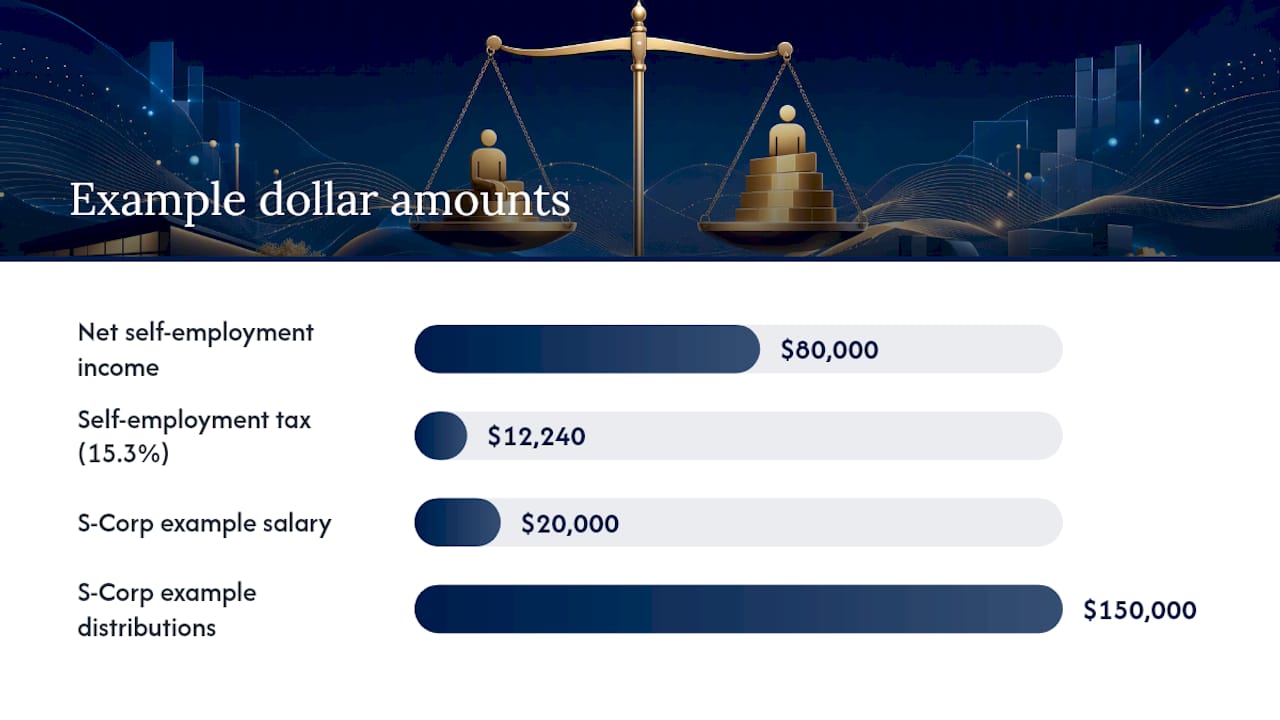
Quick math: On $80,000 of net self-employment income, 15.3% self-employment tax alone is roughly $12,240, before federal or state income tax even enters the picture.
S-Corp shareholders face a specific rule that trips up a lot of owners. The IRS requires you to pay yourself a reasonable salary before taking any distributions. “Reasonable” isn’t a number you pick out of thin air. It’s tied to what someone in your role, with your hours and responsibilities, would earn in the open market. Pay yourself $20,000 in salary while taking $150,000 in distributions from a business you run full time, and you’re a strong candidate for IRS reclassification, which can mean back payroll taxes, penalties, and interest.
The forms that matter here:
- Schedule C: Sole proprietors and single-member LLCs report net profit here.
- Form 1065 and Schedule K-1: Partnerships and multi-member LLCs report each partner’s share.
- Form 2553: Files the S-Corp election for an eligible LLC or corporation.
- Form 8832: Used for other entity classification elections, including electing C-Corp treatment.
- W-2: Reports wages for any owner-employee taking salary.
There’s also a basis issue worth understanding. Distributions and draws reduce your ownership basis in the business. Draw more than your basis and the excess can become a taxable capital gain, a detail a lot of owners never learn about until an accountant flags it during tax prep. This regulatory principle traces back to reasonable compensation standards under federal tax code, which governs when compensation counts as a deductible business expense in the first place.
Pro Tip: Keep a simple one-page file documenting how you arrived at your S-Corp salary number: comparable wage data for your role, a written job description, and hours worked per week. If the IRS ever questions your compensation, that file is the difference between a quick resolution and a drawn-out audit.
How Do You Get Paid Based on Your Business Structure?
The mechanics change entirely depending on how your business is taxed, and a lot of owners assume they have more flexibility than the law actually allows.
Sole proprietorship or single-member LLC (disregarded entity): You take draws, period. As a sole proprietor, you are not your business’s employee and do not put yourself on payroll. To be paid as an employee, the business must be taxed as a corporation—through an S-corporation election on Form 2553 or, where appropriate, a C-corporation classification election on Form 8832. A solo electrician netting $70,000 simply withdraws funds as needed and reports the full $70,000 on Schedule C, paying self-employment tax on all of it.
Partnership or multi-member LLC: Partners generally take guaranteed payments or distributions, reported on Form 1065 and each partner’s K-1. Guaranteed payments are still subject to self-employment tax, even though they’re not technically wages. Two contracting partners splitting $120,000 in profit might each take a $40,000 guaranteed payment plus a share of remaining distributions.
LLC electing S-Corp status: You must run payroll and pay yourself a reasonable W-2 salary, then take remaining profit as distributions. A general contractor who elects S-Corp on $150,000 net profit might pay himself a $70,000 salary and take $80,000 as a distribution, avoiding self-employment tax on that $80,000 portion.
C-Corp: Owner-employees receive W-2 wages just like any other employee. The corporation itself pays corporate tax on remaining profit, and any dividends distributed to shareholders get taxed again at the individual level, the classic “double taxation” scenario that makes C-Corp status rare for small owner-operated service businesses.
How Much Should You Actually Pay Yourself?
The most-cited rule of thumb among practitioners: S-Corp conversion tends to pay off once your net profit sits consistently above roughly $60,000 to $80,000 a year. Below that, payroll fees and administrative overhead often cancel out whatever self-employment tax you’d save.
Use this three-step check to land on a number:
- Figure out sustainable cash available. Look at profit after covering operating expenses, debt service, and a realistic tax reserve, not just what’s sitting in the checking account today.
- Benchmark reasonable pay for your role. Use BLS occupational wage data or regional trade association surveys to see what a manager or technician doing your job would earn if you hired them.
- Run the payroll-tax comparison. Compare total tax owed under a straight draw versus a salary-plus-distribution split at a few different salary levels before locking in a number.
For reserves, most service businesses do well holding back a portion of draws for taxes, plus a separate operating cushion of one to two months’ expenses. Trucking and construction businesses with lumpy receivables often need the higher end of that range.
Pro Tip: Save your BLS wage printout, job description, and a weekly time log showing your actual hours. That three-document file is exactly what defends a reasonable salary if the IRS ever asks you to justify it.
What Are the Steps to Set Up Your Pay Method?
- Open and maintain a dedicated business bank account. Never mix personal and business funds, even temporarily.
- Decide your method based on entity type: schedule regular draws or set up payroll.
- Choose a payroll provider or run it yourself if you’ve elected S-Corp status. Most owners are better off with a provider unless they have real payroll experience.
- Record every draw correctly in an Owner’s Equity account, never as a business expense.
- Set up estimated quarterly tax payments (draws) or confirm payroll withholding deposits are scheduled correctly (salary).
- Call your CPA or bookkeeping partner before finalizing an S-Corp election or a major salary change. Bring your last two years of profit and loss statements.
A payroll provider costs more monthly than doing it yourself, but a missed federal deposit deadline carries penalties that dwarf that fee difference. DIY payroll only makes sense if you genuinely have the bandwidth to track deposit dates without fail.
Pro Tip: Set payroll tax deposits on autopay through your provider the same week you launch. The single most common new-S-Corp mistake is missing the first quarterly deposit because nobody set a calendar reminder.
What Mistakes Put Your Business at Risk?
The costliest mistakes are also the most common ones. Commingling personal and business funds destroys the liability protection your LLC is supposed to give you. Failing to set aside tax money from draws leads to a brutal April surprise. Paying yourself an artificially low S-Corp salary to dodge payroll tax is one of the fastest ways to draw IRS attention.
A pattern of large shareholder distributions paired with little or no W-2 wages is one of the clearest audit triggers the IRS looks for in S-Corp filings, since it suggests owners are disguising compensation as distributions to avoid employment tax.
Fix these fast: separate your accounts this week if you haven’t already, automate a tax-reserve transfer on every draw, and document your salary reasoning before year-end, not after an audit notice arrives.
When Should You Bring in Professional Help?
Once your profit is consistent and your pay structure starts affecting real decisions like loan applications, it’s time to stop guessing. TrueMeasure Accounting works with HVAC, plumbing, electrical, construction, and trucking business owners on exactly this transition.
Services that map directly to this decision:
- Reasonable-salary benchmarking backed by real market data, not guesswork.
- S-Corp election support, from Form 2553 timing to payroll setup.
- Tax planning that models draw versus salary scenarios before you commit.
- Job-costing and cash-flow forecasting so your pay decision doesn’t strain operations.
One HVAC contractor client made the S-Corp split, documented a defensible salary, and freed up enough cash flow to replace an aging service truck the same quarter. Call a pro once profit clears $60,000 consistently, distributions are growing faster than salary, or a lender is asking for paystub proof of income.
What’s the Smartest Way to Approach This Decision?
Get your books clean before you touch payroll. I’ve watched owners set up an S-Corp and run payroll for months before they had accurate monthly profit numbers, which means they were guessing at a “reasonable” salary the entire time. That’s backward.
Prioritize three things this month: separate your accounts if you haven’t, get a real profit and loss statement you trust, and set aside taxes on every draw automatically. The biggest behavioral error I see isn’t picking the wrong method. It’s paying yourself nothing, or next to nothing, while the business grows around you.
Get Help Setting a Defensible Pay Strategy
Choosing between a draw and a salary is only half the problem. The harder part is proving you got the number right if the IRS ever asks, and keeping your books accurate enough to trust the decision in the first place. TrueMeasure Accounting builds that foundation for owner-operated service businesses through fixed-price monthly bookkeeping, payroll setup, reasonable-salary benchmarking, and tax planning built around how your business actually runs, not generic compliance checklists.

If you’re an HVAC contractor, plumber, electrician, trucking company owner, or general contractor trying to decide whether an S-Corp election makes sense this year, that’s exactly the kind of question our fractional CFO and tax planning work is built to answer. We’ll look at your actual profit trend, run the salary-versus-distribution math specific to your numbers, and set up clean bookkeeping so every draw or paycheck is recorded correctly from day one. Schedule a consultation and bring your last two years of financials. We’ll tell you plainly whether a change is worth it.
Frequently Asked Questions
Does an owner’s draw count as taxable income?
Not directly. The draw itself isn’t a taxable event. You owe tax on your business’s net profit reported on Schedule C or K-1, regardless of how much cash you actually withdrew during the year.
Can I pay myself both a salary and take draws?
Only if you’ve elected S-Corp or C-Corp status. Sole proprietors and default LLC owners can’t run payroll for themselves; they’re limited to draws or guaranteed payments.
How often should I pay myself?
Draws can happen as often as cash flow allows, weekly, biweekly, or monthly. Salary follows a fixed payroll schedule, usually biweekly or semimonthly, which most lenders and mortgage underwriters prefer to see.
Does an owner’s draw affect my Social Security benefits later?
Draws don’t generate W-2 wage credits, but self-employment tax paid on your net profit does count toward Social Security. Salary wages contribute the same way through FICA withholding.
Will banks view a salary more favorably than a draw when I apply for a loan?
Often, yes. A documented W-2 salary reads as stable, predictable income to underwriters, while draw income sometimes requires additional documentation to prove consistency over time.
This article is general information, not a substitute for advice from a qualified financial advisor. Consult a qualified financial professional about your own circumstances before acting on anything here.
Sources
- Paying yourself — IRS (paying yourself guidance)
- Self‑Employment Tax (Social Security and Medicare Taxes) — IRS
- S corporation compensation and medical insurance issues — IRS
- Beancount