
If you run an HVAC company, a plumbing outfit, a trucking business, or any owner-operated service business with moderate to substantial annual revenue, the right move is to hire a business bookkeeping service that pairs dedicated bookkeeping with operator-level advisory, not just data entry. TrueMeasure Accounting fits that description: monthly reconciliations, QuickBooks cleanup, financial reporting, and fractional CFO guidance built around what actually drives profitability and cash flow in a service business.
The IRS requires businesses to keep accurate records to support income, deductions, and credits reported on tax returns, which means the books you keep today decide how much stress you feel in April. TrueMeasure was founded by an operator with more than two decades running multi-million-dollar service businesses, so the monthly deliverables (reconciliations, a profit-and-loss statement, and cash flow commentary) are built to answer the questions owners actually ask: Am I making money on this job? Can I make payroll next month? Should I raise my rates?
Here’s what to have ready before you schedule a call:
- Your last 12 months of profit-and-loss statements, even if they’re messy
- Bank and credit card statements for every business account, going back at least a year
- Current QuickBooks login access (or whatever software you’re using now)
Book a discovery call, hand over that information, and a competent provider can tell you within a week or two how far behind your books really are.
Key Takeaways
Owner-operated service businesses get the most value from a business bookkeeping service that combines a dedicated bookkeeper, monthly job-costing reports, and advisory access, not just monthly data entry.
| Point | Details |
|---|---|
| Confirm industry fit | Choose a provider with real experience in trades, trucking, construction, or real estate, not general small-business bookkeeping. |
| Insist on a dedicated bookkeeper | Avoid firms that rotate staff or outsource your account to an unnamed pool. |
| Demand clear deliverables | Require a monthly P&L, cash flow summary, and job-costing report, not a raw QuickBooks export. |
| Evaluate pricing on value | A flat monthly retainer with defined scope beats the cheapest hourly rate once catch-up costs are factored in. |
| TrueMeasure Accounting fits this profile | Built for owner-operated businesses earning $250,000 to $5 million with monthly bookkeeping, QuickBooks cleanup, and fractional CFO support tied to profitability. |
Reliable books aren’t the finish line. They’re the starting point for every pricing, staffing, and growth decision you’ll make this year.
What to have ready when you call: your last 12 months of financials, a list of every bank and credit card account, and current login access to your accounting software.
Table of Contents
- What Does a Business Bookkeeping Service Actually Include?
- How Does Onboarding Work With an Outsourced Bookkeeper?
- Which Businesses Get the Most Value From Outsourced Bookkeeping?
- How Should You Choose a Bookkeeping Provider?
- What Does a Business Bookkeeping Service Typically Cost?
- What Trust Signals Should You Look for in a Provider?
- How Do You Get Started With an Outsourced Bookkeeping Service?
- Why an Operator-Founded Firm Delivers Different Outcomes
- How TrueMeasure Accounting Can Help Your Business
- Sources
What Does a Business Bookkeeping Service Actually Include?
A business bookkeeping service should deliver, at minimum, transaction categorization, monthly bank and credit card reconciliations, a month-end close, a profit-and-loss statement, a balance sheet, and a cash flow summary. Anything less than that is data entry, not bookkeeping.
Most owners have never seen a real deliverable checklist, so here’s what a serious monthly engagement looks like:
- Monthly reconciliations: every bank and credit card account matched to actual transactions, catching duplicate charges, missed deposits, and fraud early.
- Management profit-and-loss statement: not the raw QuickBooks export, but a report organized by category with commentary on what changed month over month.
- Cash flow summary or forecast: a rolling view of what’s coming in and going out over the next 30 to 90 days.
- Accounts receivable aging report: who owes you money and how long it’s been outstanding, so collections don’t slip.
- Job or customer profitability highlights: which jobs, customers, or service lines actually made money this month, not just top-line revenue.
Bookkeeping rarely stands alone. It usually pairs with QuickBooks cleanup for businesses with a year or two of messy books, payroll coordination so wages and tax deposits stay accurate, a handoff to tax preparation at year end, and fractional CFO advisory once the numbers are clean enough to plan around. The connection between clean books and profitability isn’t theoretical. Owners who can see job-level margins in real time catch pricing mistakes months before an annual tax return would ever reveal them.
If you’re a trade contractor and can only prioritize one deliverable this year, make it a clean cash flow statement paired with job costing. Everything else, including tax strategy, gets easier once you know which jobs are actually profitable and when cash actually lands in the bank.
Pro Tip: Ask any prospective provider to show you a sample job-costing report before you sign anything. If they can’t produce one that breaks profit down by job or customer, they’re not built for a trade business.
How Does Onboarding Work With an Outsourced Bookkeeper?
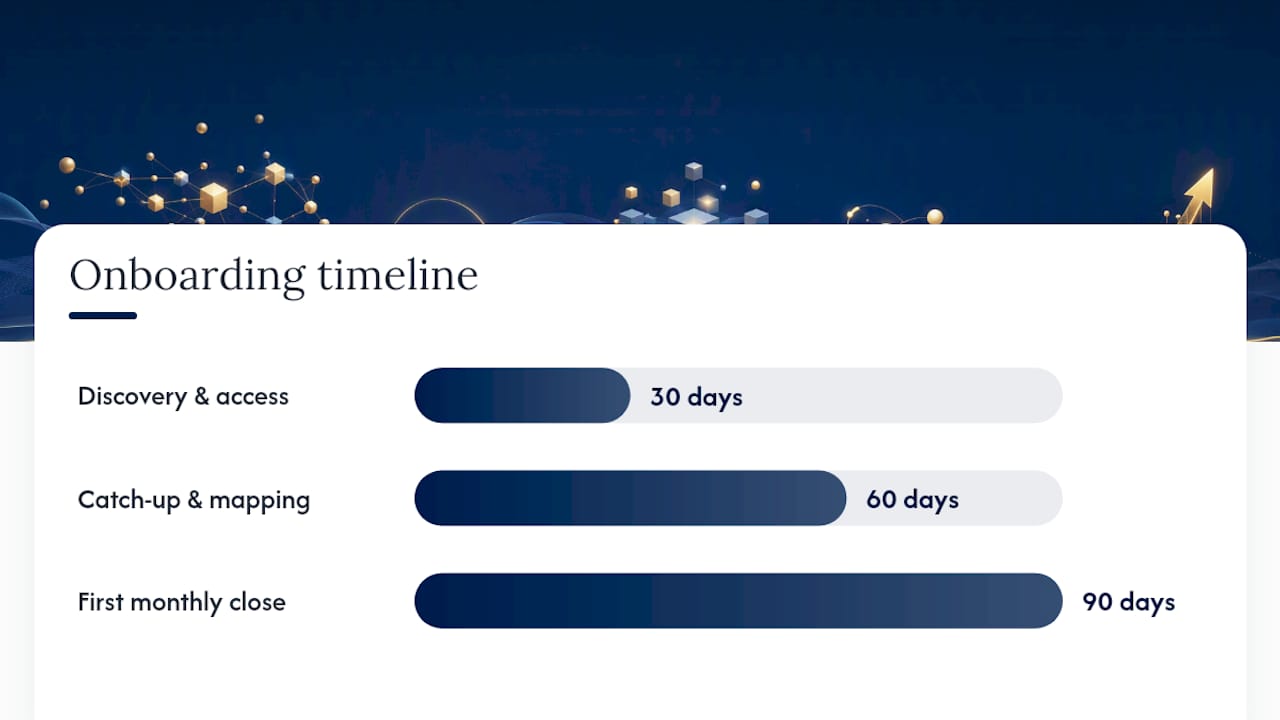
Onboarding with a quality bookkeeping service runs through three phases: discovery and access setup in the first 30 days, catch-up or cleanup work and chart-of-accounts mapping through day 60, and your first full monthly close with baseline KPIs by day 90.
The actual sequence typically looks like this:
- Discovery call: the provider reviews your current books, software, and transaction volume to estimate the scope of work.
- Cleanup and catch-up estimate: if your books are behind or disorganized, the provider quotes a fixed-fee project to bring them current before monthly service starts.
- Data access and permissions: you grant read or limited access to bank feeds, credit cards, and accounting software, ideally through a secure client portal rather than shared logins.
- Chart of accounts mapping: categories get rebuilt or cleaned so reports reflect how your business actually operates (by job, by service line, by crew).
- First month-end close: reconciliations run, and you receive your first set of baseline reports.
- KPI setup: the provider and owner agree on the two or three numbers that matter most (gross margin by job, labor cost percentage, days sales outstanding) and start tracking them monthly.
Timeline varies with how bad the starting point is. A business with clean, current QuickBooks and moderate transaction volume can be fully onboarded and producing monthly closes within 30 days. A business with two years of uncategorized transactions, mixed personal and business expenses, or multiple unreconciled bank accounts often needs 60 to 90 days of catch-up work before monthly service even begins. Transaction volume, the number of bank accounts, and whether payroll runs through the same system all affect how long that catch-up takes.
Before your first call, gather a list of every bank and credit card account tied to the business, current login credentials or a plan to grant secure access, and copies of the last two tax returns. Providers that handle this well often use secure document-exchange tools such as encrypted client portals or a shared drive, rather than emailing sensitive files back and forth.
TrueMeasure Accounting was built on the premise that whoever’s running your books should understand how a service business actually operates, not just how to close a ledger. That operational lens comes directly from founder Anthony Boncimino’s two decades running multi-million-dollar service businesses before starting the firm.
Which Businesses Get the Most Value From Outsourced Bookkeeping?
The ideal client for an outsourced business bookkeeping service is an owner-operated company with annual revenues in a range indicating the need for more than basic compliance but isn’t ready to hire a full-time controller or CFO. That range covers HVAC companies, plumbing and electrical contractors, general contractors, trucking and transportation businesses, property managers, real estate investors, and small professional service firms.
Below that revenue threshold, transaction volume is usually light enough that a simple software subscription or a part-time bookkeeper covers the basics. Above $5 million, or once a business has layered payroll complexity, multiple locations, or investor reporting requirements, the need typically shifts toward a full internal finance team or a dedicated CFO rather than an outsourced arrangement.
The businesses that see the highest return share a few traits: complex job costing needs, payroll with multiple pay rates or union rules, high transaction volume across several bank accounts, or seasonal cash flow swings that make forecasting essential. A growing business considering outsourced accounting usually hits this point when the owner realizes they can’t answer basic questions about which jobs are profitable without digging through spreadsheets for hours.

A few scenarios show up constantly. A plumbing company running five crews needs to know whether Tuesday’s water heater install actually made money after labor, materials, and drive time, not just whether the invoice got paid. A trucking business owner with fifteen trucks needs a rolling cash flow forecast because fuel costs and factoring fees can swing weekly margins by thousands of dollars. A real estate investor holding a dozen rental properties needs monthly reporting broken out by property, because one underperforming unit can quietly drag down returns on an otherwise strong portfolio.
Businesses that don’t fit this model include the smallest owner-operators with minimal transaction volume who can reasonably handle DIY bookkeeping software on their own, and larger enterprises that have outgrown outsourced support entirely and need an in-house finance department.
How Should You Choose a Bookkeeping Provider?
Choosing a bookkeeping provider comes down to five criteria: industry specialization, a dedicated bookkeeper (not a rotating pool), a clearly defined monthly scope, a modern technology stack with integrations, and access to advisory or fractional CFO support when you’re ready for it.
The differences between service tiers are significant enough to map out directly:
| Service Model | Books Ownership | Monthly Reports | Advisory Access | Typical Pricing |
|---|---|---|---|---|
| In-house part-time bookkeeper | Owner or staff manage oversight | Basic, often inconsistent | Rare, usually none | Hourly wage plus benefits |
| Basic outsourced bookkeeping | Provider owns data entry only | Standard P&L, minimal commentary | Not included | Flat monthly fee, lower tier |
| Operator-focused outsourced service | Provider owns full close and reconciliation | Detailed P&L, cash flow, job costing | Fractional CFO available | Flat monthly fee, scaled to complexity |
When you interview a prospective provider, ask direct questions and pay attention to how specific the answers are:
- Who specifically will handle our books, and will that person change over time?
- How often will we meet, and what does that meeting cover?
- What does your month-end close checklist look like?
- How do you handle catch-up or cleanup work if our books are behind?
- Can you produce a sample job-costing or profitability report similar to what we’d need?
- What happens if we need to talk to someone between scheduled meetings?
Watch for warning signs during that conversation. Red flags include a provider who won’t offer a demo or sample report before you sign, vague or nonexistent month-end deliverables, unclear answers about who has access to your financial data, and a refusal to connect you with a current client in a similar industry. Bookkeeping errors that go unnoticed for months almost always trace back to one of these red flags being ignored during the hiring process.
What Does a Business Bookkeeping Service Typically Cost?
Bookkeeping services are usually priced through a flat monthly retainer, occasionally through transaction-based tiers, and cleanup or catch-up work is typically billed as a fixed-fee project separate from ongoing service. A flat monthly fee gives you a predictable line item instead of a surprise invoice, which matters more than it sounds once you’re managing cash flow across a growing crew.
Several factors drive that monthly price up or down: how many transactions run through the business each month, how many bank accounts and credit cards need reconciling, whether payroll runs through the same books, how much catch-up work is needed at the start, and whether you need integrations with job-costing or field service software.
Complexity changes the picture fast. An HVAC contractor running four trucks, a payroll of eight technicians, financed equipment, and multiple bank accounts is a fundamentally different engagement than a solo consultant with one bank account and a handful of monthly invoices. The contractor needs job costing tied to service tickets, payroll tax coordination, and probably a cash flow forecast built around seasonal demand. The consultant needs clean categorization and a simple monthly P&L. Pricing reflects that gap in scope, not an arbitrary rate card.
The value case matters more than the sticker price. Accurate books typically pay for themselves through better pricing decisions once you can see true job margins, fewer surprises at tax time because nothing was miscategorized for eleven months, and cash flow decisions made with real numbers instead of a gut check on the bank balance. Owners who choose the cheapest option on price alone often end up paying for a cleanup project a year later anyway.
What Trust Signals Should You Look for in a Provider?
The strongest trust signals in a business bookkeeping service are a dedicated bookkeeper assigned to your account, a documented onboarding and monthly cadence, an accessible demo or contact process, verifiable client testimonials or case studies, clear security and data access controls, and demonstrated experience in your specific industry.
Before committing, ask a provider to produce proof rather than promises:
- A sample anonymized monthly report similar to what you’d receive
- A case study or reference from a client in a comparable industry (HVAC, trucking, construction)
- A direct reference call with a current client
- A written summary of their security controls and data access policy
Security deserves real scrutiny, not a passing mention. Expect least-privilege access so staff only see what they need, multi-factor authentication on any portal touching your financial data, and secure document exchange rather than email attachments for sensitive files like bank statements or tax returns. Ask what insurance or professional certifications the firm carries, and don’t accept a vague answer.
During evaluation, ask specifically for examples of job-costing reports the provider produces for contractors, since that single request filters out firms that only do compliance-level data entry. Inc. has covered how virtual accounting firms that invest in documented processes and team culture tend to deliver more consistent client service, and industry recognition programs increasingly single out firms building that kind of operational discipline into virtual bookkeeping.
How Do You Get Started With an Outsourced Bookkeeping Service?
Getting started takes three actions: schedule a discovery call, gather your financial documents and software access, and agree on scope and timeline before any work begins.
Before that first meeting, pull together your last 12 months of profit-and-loss statements, bank and credit card statements for every account, a summary of payroll if you have employees, a list of your major vendors, and access credentials for QuickBooks or whatever software you currently use. The more organized this packet is, the faster a provider can scope your engagement accurately instead of guessing.
Expect a rough rhythm over the first 90 days. By day 30, you should have granted access and received a cleanup estimate if your books need catch-up work. By day 60, your chart of accounts should be mapped and cleanup work should be substantially complete. By day 90, you should be receiving your first full monthly close with baseline reports and two or three KPIs you’ve agreed to track going forward.
If you have an office manager or operations lead, hand them a short internal task list: pull the last 12 months of financials, compile a list of every bank and credit card account, gather QuickBooks login information, and schedule the discovery call. That single handoff removes most of the friction that stalls onboarding for busy owners.
Why an Operator-Founded Firm Delivers Different Outcomes
An accounting firm founded by someone who has actually run a service business translates bookkeeping into decisions about pricing, staffing, and job selection, not just tax compliance. That distinction sounds small until you watch it play out in a real engagement.
Most bookkeepers can tell you what happened last month. An operator-founded firm asks a different question: what should you do next month because of what happened? I’ve seen this play out with contractors who assumed their busiest crew was also their most profitable one, only to find through proper job costing that a single low-margin recurring account was eating their labor capacity while a smaller, higher-margin service line went understaffed. The fix wasn’t a new accounting system. It was a fifteen-minute conversation once the numbers made the problem visible.
That’s the pattern worth expecting from a bookkeeping partner: improved job margin reporting that leads directly to an adjusted labor rate or a renegotiated contract, not a report that sits unread in an inbox. Understanding how financial reporting actually works for a small business matters less than having someone translate that report into a decision you can act on this quarter.
The gap between what most bookkeeping services promise and what they deliver almost always comes down to this: data entry versus interpretation. Clean books are the floor, not the ceiling.
How TrueMeasure Accounting Can Help Your Business
TrueMeasure Accounting is built specifically for owner-operated service businesses that need more than a data-entry bookkeeper but aren’t ready to hire a full-time CFO. If you’re running an HVAC company, a plumbing business, a trucking fleet, or a construction firm and spending your evenings trying to figure out which jobs actually made money, that’s precisely the gap this firm fills.
The engagement includes a dedicated bookkeeper who knows your business, a monthly profit-and-loss statement with commentary explaining what changed and why, job-costing reports broken down by customer or project, fixed monthly pricing so you know your cost in advance, and a straight handoff to tax preparation when the time comes. Businesses that outgrow basic monthly bookkeeping can add fractional CFO advisory without switching providers or rebuilding their financial history from scratch.
The typical client generally works within a revenue range suited to TrueMeasure’s services and works with TrueMeasure through a monthly retainer, sometimes paired with a fixed-fee cleanup project if the books are behind when they start. If that sounds like your business, the next step is straightforward: visit the bookkeeping services page or reach out through the industry-specific services page to see how the firm works with businesses like yours, then schedule a discovery call. After that call, expect a scoped proposal within a few days outlining catch-up work if needed and what your first 90 days will look like.
Sources
Owners preparing to hire a bookkeeping provider will get the most value from these six resources, covering recordkeeping rules, profitability, tax readiness, and service scope.
- Small Business and Self-Employed Tax Center | Internal Revenue Service
- These virtual accounting visionaries designed an award-winning culture | Inc.
Use the IRS resource to confirm your recordkeeping obligations, and use the TrueMeasure links to understand exactly what a modern bookkeeping engagement should look like before you sign anything.