
Accrual accounting is defined as the method of recording revenue when it is earned and expenses when they are incurred, regardless of when cash actually changes hands. For service businesses, this is the standard that GAAP and IFRS require for any company seeking audits or external financing. It gives you a financial picture that reflects what your business actually earned and spent in a given period, not just what hit your bank account. If you run an HVAC company, a plumbing operation, a construction firm, or any other service business, understanding what accrual accounting means for your business is the difference between making decisions on real numbers and making decisions on guesswork.
What is accrual accounting for a service business?
Accrual basis accounting records a transaction the moment the economic event occurs. You complete a $15,000 HVAC installation in march. Under accrual accounting, that $15,000 appears as revenue in march, even if the client pays 45 days later. The same logic applies to expenses: if you order $3,000 in materials in march and the invoice arrives in april, accrual accounting records that cost in march, matching it to the job it supported.
The industry term for this logic is the matching principle. It pairs revenues and expenses in the same reporting period so your income statement reflects true profitability for that period. Without it, a month where you did $80,000 in work but collected nothing looks like a loss, and a month where three clients paid old invoices looks like a windfall.
GAAP and IFRS mandate accrual accounting for any business that requires audited financials. Auditors will not issue opinions on financial statements compiled on a cash basis. That matters the moment you apply for a bank line of credit, seek an SBA loan, or bring in an outside investor.

Under ASC 606, the current revenue recognition standard, service businesses recognize revenue over time as they satisfy performance obligations, not when cash is received. A six-month retainer contract is recognized monthly as the service is delivered. This reflects economic reality far more precisely than recording the full payment when the check clears.
How does accrual accounting affect financial reporting for service businesses?
Accrual accounting produces three financial statements that tell a complete story: the income statement, the balance sheet, and the statement of cash flows. Each one depends on accurate accrual entries to be meaningful.
The income statement under accrual
Your income statement shows revenue earned and expenses incurred in a specific period. For a plumbing company running 12 active service contracts, the income statement under accrual shows the revenue from all 12 contracts as it is earned each month, whether or not every client has paid. This gives you a true gross margin for the period. Cash basis would show only what was collected, making your margins look inconsistent and unreliable.
The balance sheet and working capital
Accrual accounting creates accounts receivable and accounts payable on your balance sheet. Accounts receivable represents money clients owe you for completed work. Accounts payable represents what you owe vendors and subcontractors. Together, these two figures define your working capital position. A contractor with $200,000 in receivables and $60,000 in payables has a very different financial position than the bank balance alone suggests.
Deferred revenue also appears on the balance sheet under accrual. If a property management client pays you $12,000 upfront for a year of service, you cannot recognize all of it immediately. You recognize $1,000 per month as you deliver the service. That unearned portion sits as a liability until you earn it.
Pro Tip: Review your accounts receivable aging report every two weeks. Receivables over 60 days old are a cash flow risk, not just a bookkeeping entry. Catching them early gives you time to collect before they become write-offs.
Cash basis vs. accrual: a direct comparison
| Scenario | Cash basis result | Accrual basis result |
|---|---|---|
| $20,000 job completed; client pays in 60 days | Revenue recorded in month 2 | Revenue recorded in month 1 |
| $5,000 materials purchased; invoice due in 30 days | Expense recorded when paid | Expense recorded when incurred |
| $12,000 annual retainer received upfront | Full revenue in month 1 | $1,000 revenue recognized each month |
| Subcontractor paid after job closes | Expense in payment month | Expense matched to job period |
The table above shows why cash basis distorts profitability for service companies with any lag between work delivery and payment.
What are the main benefits and challenges of accrual accounting?
Accrual accounting gives service business owners a financial picture they can actually use to run the business. The benefits go well beyond compliance.
Key benefits for service companies
- Accurate profitability by period. You see what each month actually cost and earned, not what happened to clear the bank. This matters when you are evaluating whether a service line is worth keeping.
- Better cash flow forecasting. Tracking receivables and payables lets you anticipate liquidity needs weeks ahead. You know a $40,000 receivable is coming before it arrives, so you can plan payroll and vendor payments with confidence.
- Loan and credit readiness. Banks and lenders require accrual-based financials. A service business with clean accrual books gets faster approvals and better terms.
- Pricing and staffing decisions. When you can see true job-level profitability, you can price new contracts correctly and identify which service lines are dragging down margins.
- Reduced tax bracket surprises. Accrual smooths income recognition over the contract period, reducing the income spikes that push you into a higher tax bracket when a large payment lands.
The real challenges you need to plan for
Accrual accounting is more demanding than cash basis. Tracking unbilled receivables, deferred revenue, and contract progress adds bookkeeping complexity that small teams without dedicated finance support may struggle to manage. The most common pitfalls service businesses face when transitioning include:
- Forgetting to record accrued expenses at month-end, which overstates profit
- Misclassifying upfront client payments as revenue instead of deferred revenue
- Failing to reconcile accounts receivable regularly, which hides collection problems
- Confusing a profitable income statement with a healthy cash position
That last point is critical. A service business can show strong net income on an accrual income statement while running out of cash because clients are slow to pay. Accrual accounting does not eliminate cash flow problems. It makes them visible so you can act on them. For a deeper look at why profitable businesses still run short on cash, profitable businesses run out of cash more often than most owners expect.
Pro Tip: Set up a deferred revenue schedule in a simple spreadsheet or your accounting software. Update it monthly. This one habit prevents the most common accrual accounting error service businesses make.
How does accrual accounting compare to cash basis for service companies?
The choice between accrual and cash basis accounting is not purely a preference. It depends on your business size, contract structure, financing needs, and growth plans.
When cash basis still makes sense
Cash basis works well for very small service firms with short contracts and immediate payment cycles. A solo electrician who invoices and collects on the same day has little to gain from accrual complexity. The bookkeeping overhead may genuinely outweigh the benefit when contracts are simple and cash turns over quickly.
When accrual becomes necessary
Accrual accounting becomes necessary as your business grows, takes on longer contracts, or seeks outside financing. Service businesses under $31 million in annual gross receipts may choose either method for tax purposes under IRS Rev. Proc. 2025-9. Above that threshold, accrual is required for tax reporting as well. Switching from cash to accrual for tax purposes requires filing IRS Form 3115. Switching back is significantly harder and requires evidence of a revenue threshold change.
The hybrid approach most growing firms use
Many successful service firms report internally on an accrual basis but file taxes using cash basis when eligible. This hybrid approach gives you the operational clarity of accrual financials while preserving the tax simplicity of cash reporting. The two sets of books are reconciled through professional adjusting entries at year-end. Sophisticated firms maintain accrual books year-round and convert to cash basis for tax returns under the IRS books-and-records method, applying it consistently to avoid scrutiny.
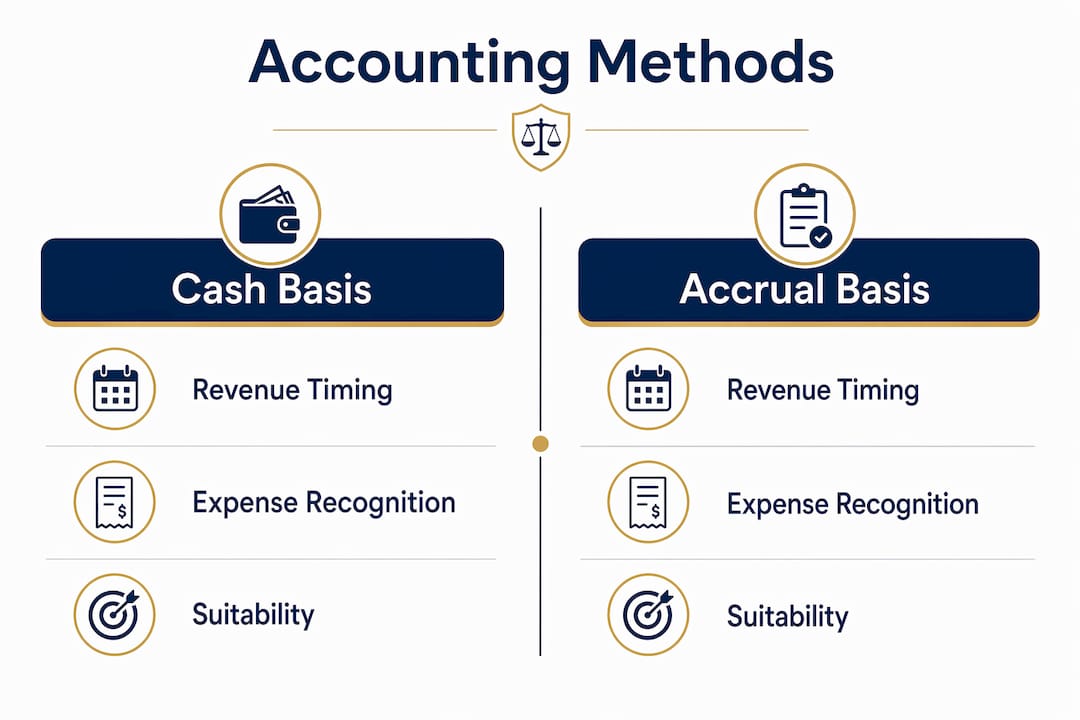
| Factor | Cash basis | Accrual basis |
|---|---|---|
| Revenue timing | When cash is received | When service is performed |
| Expense timing | When cash is paid | When cost is incurred |
| Financial accuracy | Lower for multi-period contracts | Higher across all contract types |
| Loan and audit readiness | Not accepted | Required |
| Tax filing eligibility | Under $31M gross receipts | All business sizes |
| Bookkeeping complexity | Lower | Higher |
The hybrid model is the right answer for most service businesses generating between $500,000 and $5 million annually. You get decision-ready financials internally and tax efficiency externally.
What are the practical steps for implementing accrual accounting?
Setting up accrual accounting correctly from the start saves you significant cleanup work later. These steps apply whether you are transitioning from cash basis or starting fresh.
-
Set up your chart of accounts for accrual. Add accounts for accounts receivable, accounts payable, accrued liabilities, and deferred revenue. These accounts do not exist in a pure cash basis system. Your accounting software, whether QuickBooks or another platform, supports all of these natively.
-
Record revenue when work is performed, not when payment arrives. Create invoices the moment a job is complete or a service milestone is reached. Do not wait for payment to enter the transaction. This single discipline is the foundation of accurate accrual reporting.
-
Record expenses when incurred, not when paid. When you receive a vendor invoice, enter it immediately as accounts payable. This matches costs to the period they belong to and prevents profit overstatement. Accurate expense management is what separates a reliable income statement from a misleading one.
-
Set up a deferred revenue schedule. For any client who pays upfront for future services, track the unearned portion separately. Recognize revenue monthly as you deliver the service. This is non-negotiable under ASC 606 for multi-period contracts.
-
Perform monthly reconciliations and adjusting entries. At the end of every month, reconcile accounts receivable and accounts payable to your general ledger. Record accrued expenses for any costs incurred but not yet invoiced. These adjusting entries are what make accrual accounting accurate.
-
Use accrual reports to drive business decisions. Review your monthly income statement by service line or job type. Compare gross margins across different contract types. Use accounts receivable aging to manage collections. These reports are where accrual accounting pays for itself. Employee profitability tracking becomes far more reliable when the underlying financials use accrual principles.
-
Prepare for year-end tax adjustments. If you use the hybrid approach, work with your accountant to prepare the adjusting entries that convert your accrual books to cash basis for tax filing. Document the process consistently each year to satisfy IRS requirements.
Key Takeaways
Accrual accounting gives service businesses the financial accuracy needed to make real decisions on profitability, cash flow, and growth, while cash basis accounting only tells you what cleared the bank.
| Point | Details |
|---|---|
| Core definition | Accrual records revenue when earned and expenses when incurred, not when cash moves. |
| GAAP and IFRS requirement | Audited financials and bank financing require accrual basis accounting without exception. |
| Matching principle | Pairing revenues and expenses in the same period reveals true job and period profitability. |
| Hybrid approach | Many service firms use accrual internally and cash basis for taxes, reconciled at year-end. |
| IRS threshold | Businesses under $31M gross receipts may choose their tax method per IRS Rev. Proc. 2025-9. |
Why most service business owners are reading their financials wrong
I spent over 20 years building and running service businesses before I ever worked in accounting. And the single biggest financial mistake I watched owners make, including myself early on, was trusting their bank balance as a proxy for profitability.
Cash basis accounting feeds that mistake. When you only see what hit your account, a good collection week feels like a good business week. But those are two completely different things. I have seen HVAC companies with $2 million in annual revenue that had no idea which service lines were actually profitable because their books never matched revenue to the period it was earned.
Accrual accounting forces honesty. It shows you what you earned in a period, what it cost you to earn it, and what you are still owed. That information is what you need to price a new contract correctly, decide whether to hire another technician, or negotiate a line of credit with a bank.
The complexity argument against accrual is real but overblown. Yes, it requires more bookkeeping discipline. But the cost of that discipline is far lower than the cost of making a $50,000 hiring decision based on a cash basis income statement that looks profitable only because three slow-paying clients happened to pay in the same month.
The hybrid approach is what I recommend to most growing service businesses. Keep your internal books on accrual. File taxes on cash basis if you qualify. Get the clarity you need to run the business without giving up tax efficiency. The key is having a bookkeeper or accountant who understands both methods and can reconcile them cleanly at year-end. That is not a luxury. It is a basic requirement for running a service business at any meaningful scale.
— Tony
Truemeasureaccounting helps service businesses get their books right
Service businesses that run on accrual accounting make better decisions. They know their real margins, manage cash flow with confidence, and walk into a bank meeting with financials that hold up to scrutiny.
Truemeasureaccounting works with HVAC companies, plumbing and electrical contractors, construction firms, and other owner-operated service businesses to set up and maintain accrual-based books that actually reflect how the business performs. From monthly bookkeeping services to financial reporting and fractional CFO support, the firm connects your numbers to the decisions that drive growth. If your current books are on cash basis and you are ready to see what your business actually earns, see how it works and schedule a conversation with the team.
FAQ
What is accrual accounting in a service business?
Accrual accounting records revenue when a service is performed and expenses when they are incurred, regardless of when cash is received or paid. This method follows GAAP and IFRS standards and gives service businesses an accurate view of profitability by period.
How does accrual accounting differ from cash basis for service companies?
Cash basis records transactions only when cash moves, while accrual records them when the economic event occurs. For service companies with multi-period contracts or delayed payments, accrual produces far more accurate financial statements.
Do small service businesses have to use accrual accounting?
Under IRS Rev. Proc. 2025-9, service businesses with annual gross receipts under $31 million may choose either cash or accrual for tax purposes. However, any business seeking audited financials or bank financing must use accrual basis accounting.
What is the matching principle in accrual accounting?
The matching principle requires that expenses be recorded in the same period as the revenue they helped generate. It is the core mechanic of accrual accounting and the reason it produces more accurate profitability data than cash basis.
Can a service business use accrual internally and cash basis for taxes?
Yes. Many service firms maintain accrual books for internal reporting and convert to cash basis for tax filing through year-end adjusting entries. This hybrid approach is allowed under the IRS books-and-records method when applied consistently each year.