
Business meals are still deductible in 2026, but a major carve-out just disappeared: employer-operated eating facilities and many “convenience of the employer” on-site meals lose their deduction entirely for amounts paid or incurred after December 31, 2025. If you run a shop, jobsite, or fleet operation that has been feeding crews on the house, this rule change hits your bottom line starting with your 2026 books.
Here’s the fast version before we get into the mechanics:
- Client and travel meals stay 50% deductible when you meet the standard substantiation rules (ordinary, necessary, not lavish, business purpose documented, taxpayer or employee present).
- Several categories remain 100% deductible, including company-wide social events, meals treated as taxable compensation to employees, and meals you sell to customers as part of your business.
- Employer-provided on-site convenience meals and cafeteria costs generally become nondeductible for amounts incurred after December 31, 2025, per Treasury’s implementing guidance under Section 274(o).
Pro Tip: Don’t wait for your CPA to flag this during tax prep. Pull your 2026 meal and cafeteria spending now and sort it into “client facing,” “compensation,” and “on-site convenience” before your bookkeeper closes another month using last year’s coding.
Key Takeaways
| Point | Details |
|---|---|
| Identify on-site meal programs now | Map every cafeteria, break room, and shift-meal program before your bookkeeper closes another month. |
| Reclassify your chart of accounts | Split meals into client/travel (50%), compensation/events (100%), and nondeductible on-site categories. |
| Consider taxable compensation conversion | Running convenience meals through payroll as taxable wages restores full deductibility. |
| Keep full substantiation on every meal | Document date, amount, place, business purpose, and attendee relationships for each deductible meal. |
| Get a coordinated review before year-end | Truemeasureaccounting can rebuild your meal-related GL coding and align it with payroll and job costing. |
Table of Contents
- What Changed in 2026: Statutes, Regulations, and Effective Dates
- What’s Deductible vs. Nondeductible for Your Business
- Recordkeeping and Substantiation You’ll Need
- How to Report Meal Deductions on Your 2026 Return
- Real-World Scenarios for Service Businesses
- Your Year-End Planning Checklist
- Myths, Misclassifications, and Audit Red Flags
- TrueMeasure Accounting’s Take: Where the Real Money Sits
- Get Your 2026 Meal Deductions Handled Correctly
- Sources
What Changed in 2026: Statutes, Regulations, and Effective Dates
The 2026 shift traces back to the One Big Beautiful Bill Act (OBBBA) and Treasury’s follow-up regulatory action under Internal Revenue Code Section 274(o), which eliminated the deduction for operating an employer eating facility and for many meals furnished for the convenience of the employer. Treasury’s decision, detailed in TD 9925, sets the effective date at amounts paid or incurred after December 31, 2025. That means your 2025 books can still reflect the old treatment, but every dollar spent on those same programs starting January 1, 2026 needs new coding.
Bloomberg Tax’s 2026 guidance summary frames the change simply: ordinary business meals with clients or during travel keep their familiar 50% limitation, but the on-site meal programs many employers built into their culture, break rooms, shift meals, subsidized cafeterias, no longer qualify for any deduction unless a specific exception applies.
Firm-level comparisons from LarsonGross walk through the same before/after pattern: what used to be a routine 50% write-off for keeping crews fed on-site now needs a business justification strong enough to survive an audit, or it gets zeroed out entirely. The bottom line for planning purposes:
- Employer-operated eating facilities lose their deduction outright.
- Convenience-of-employer meals (the classic “we feed the crew so they don’t leave the jobsite” arrangement) follows the same fate.
- Client meals, prospect meals, and travel meals keep their 50% limitation, unchanged.
- A handful of exceptions, company parties, compensation treatment, and promotional meals, survive at 100%.
What’s Deductible vs. Nondeductible for Your Business
Sorting your meal spending into the right bucket now saves you a painful reclassification project at tax time. Here’s how the categories break down for 2026.
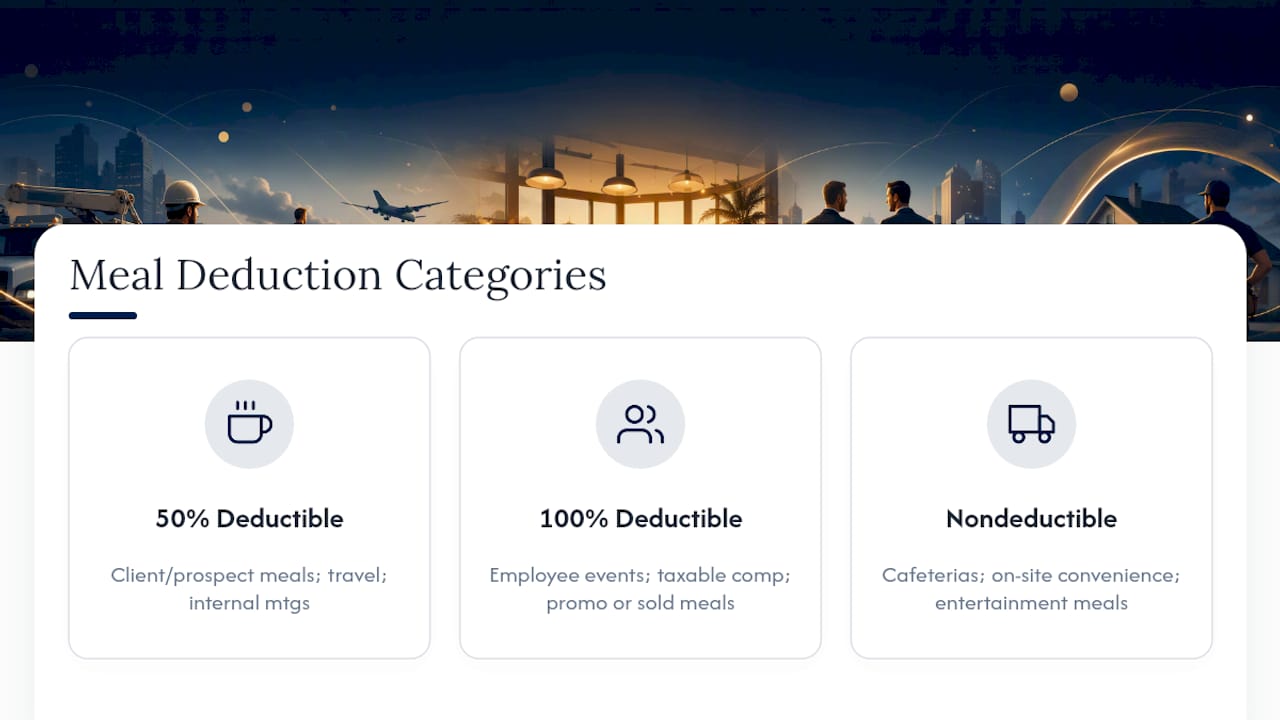
50% deductible, if you meet the conditions. This bucket covers client meals, meals with prospects during a sales pitch, meals during business travel, and food at internal business meetings. The qualifying conditions haven’t changed: the expense has to be ordinary and necessary for your trade, you or an employee has to be present, the meal can’t be lavish or extravagant under the circumstances, and you need documented business purpose. Jackson Hewitt’s 2026 breakdown lists these as the categories most owner-operated businesses use routinely, taking a customer to lunch, buying dinner for the crew during an out-of-town job, grabbing coffee during a vendor negotiation.
Company-wide social events (the holiday party, the annual crew barbecue) stay fully deductible as long as they’re primarily for the benefit of employees generally, not just executives. Meals you treat as taxable compensation, meaning you report the value on the employee’s W-2 and run it through payroll, remain 100% deductible because the IRS already taxed the benefit on the employee side. Promotional meals given away as part of marketing (think a contractor hosting a free lunch-and-learn for potential clients) and meals you actually sell to customers as part of your business also qualify.
Nondeductible starting 2026. This is the category that catches owner-operated businesses off guard. Employer-operated cafeterias, on-premises convenience meals (feeding a trucking dispatch team so they don’t leave the yard, stocking a jobsite trailer fridge as a matter of policy), and meals bundled with entertainment activities now lose their deduction. A construction company that’s been buying lunch for the whole crew every Friday “because it’s easier than everyone leaving the site” needs a new answer for why that spending qualifies, or it needs to go on the books as nondeductible.
Recordkeeping and Substantiation You’ll Need
The IRS hasn’t relaxed its documentation standard just because the deduction categories shifted. You still need five things on every meal expense you plan to deduct: date, amount, place, business purpose, and the names and business relationship of the people at the table. Wipfli’s 2026 analysis points out that even small-dollar meals need this level of detail, receipts alone don’t establish business purpose, and an auditor asking “who was at this dinner and why” is a routine occurrence, not a worst-case scenario.
A simple record template solves most of this. Track these fields directly in your expense app or general ledger memo field:
| Field | What to Capture |
|---|---|
| Date and amount | Exact date and dollar total of the meal |
| Location | Restaurant or venue name |
| Business purpose | One sentence: what was discussed or accomplished |
| Attendees | Names and business relationship (client, vendor, employee) |
| Category tag | 50% deductible, 100% deductible, or nondeductible |
Update your chart of accounts now, not in March. Split your old “Meals & Entertainment” account into at least three: client and travel meals (50%), compensation and event meals (100%), and on-site/convenience meals (nondeductible). If you allocate costs by job or project, tag these the same way in your job-costing system so a nondeductible cafeteria subsidy doesn’t quietly inflate a job’s apparent cost basis.
Pro Tip: Build a month-end checklist item that requires whoever codes meal expenses to assign a category tag before the books close. Catching a miscoded $4,000 monthly cafeteria bill in month one is a five-minute fix. Catching twelve months of it in March is a reconstruction project.
How to Report Meal Deductions on Your 2026 Return
Where this shows up on your return depends on your entity structure, but the mechanics are consistent across forms.
- Sole proprietors and single-member LLCs report deductible meals as part of business expenses on Schedule C, typically within the “other expenses” or a dedicated meals line depending on your software.
- C corporations report meal expenses on Form 1120, and any nondeductible portion needs a Schedule M-1 adjustment reconciling book income to taxable income, since your books may still show the full cafeteria cost as an expense while the tax return backs out the nondeductible amount.
- Partnerships and multi-member LLCs handle this similarly on Form 1065, with nondeductible amounts flowing through as a separately stated item on Schedule K-1 so each partner’s basis reflects it correctly.
The core book-to-tax adjustment is straightforward once your chart of accounts is split correctly: your bookkeeping shows the full cash outlay for cafeteria and convenience meals, but your tax return removes 100% of that amount as nondeductible, while the 50% limitation still applies separately to your client and travel meal accounts. If you’re relying on an exception, say, arguing that your on-site meals qualify because of an unusual work location or safety condition, keep a written policy memo on file. It won’t get filed with your return, but it’s exactly what a preparer or auditor will ask for first.
Real-World Scenarios for Service Businesses
Rules read differently once you map them to an actual jobsite or dispatch office. Here’s how four common situations shake out under the 2026 changes.
HVAC company taking a builder to lunch. A residential HVAC contractor treats the local homebuilder’s project manager to lunch to discuss an upcoming subdivision contract. Client present, business purpose documented, receipt kept.
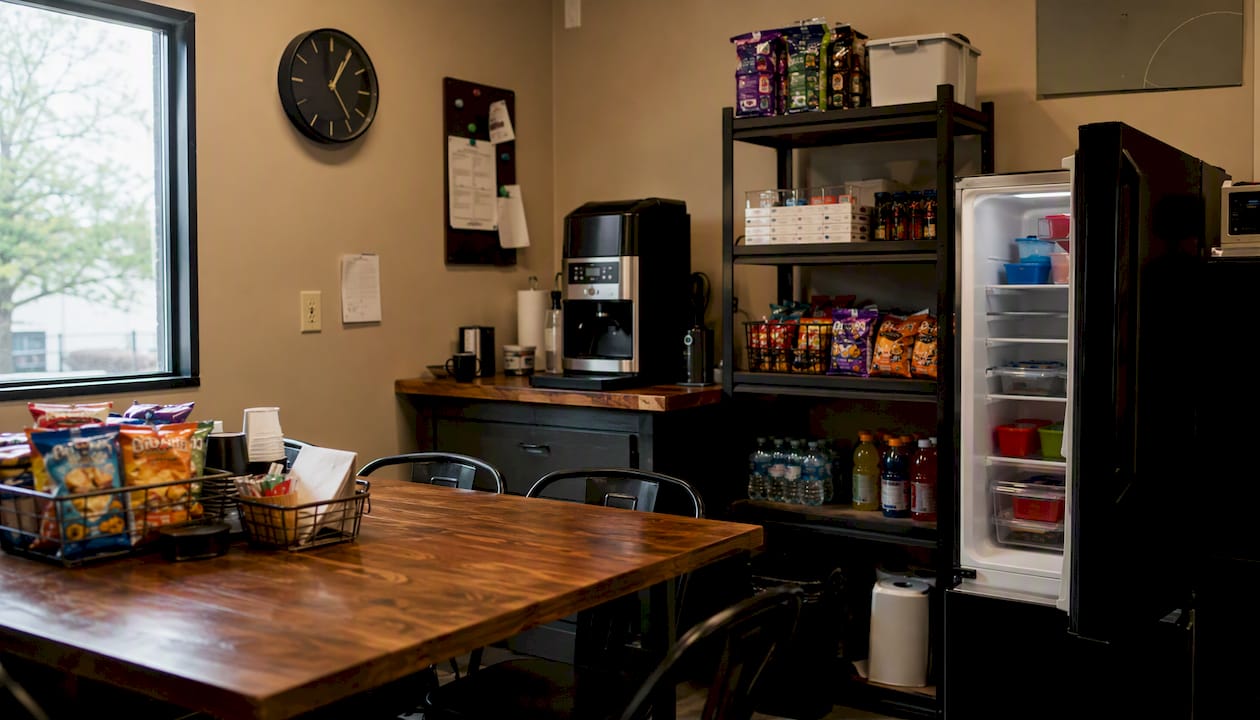
Trucking company feeding the dispatch team on-site. A trucking company has stocked its dispatch office break room and provided free lunch for dispatchers and yard staff for years, arguing it keeps people on-site during peak dispatch hours. Under the 2026 rules, this is squarely inside the convenience-of-employer category that just lost its deduction. The spending doesn’t have to stop, but it needs to move to a nondeductible GL account.
General contractor’s annual crew appreciation event. A construction company holds an annual cookout for the whole crew, all employees invited, not just management.
Electrical contractor converting meal subsidies to taxable pay. An electrical contracting firm decides to keep subsidizing lunch for field crews but restructures it: instead of an untracked convenience benefit, the value gets added to each employee’s W-2 as taxable compensation and run through payroll.
For chart-of-accounts coding, operational guidance from LGT CPA recommends separate GL codes for at minimum: client/travel meals, compensation meals, company events, and nondeductible on-site meals, with job-costing tags mirroring the same split so project profitability reports aren’t distorted by expenses that don’t reduce your tax bill. If you run employee charge cards for meals or supply a break-room account, route those transactions through the same coding discipline rather than lumping them into a general “supplies” account where they’ll never get reviewed.
Pro Tip: Run a quarterly reconciliation specifically on your meals accounts, not just at year-end. This is a fifteen-minute task quarterly versus a multi-hour cleanup in April.
Your Year-End Planning Checklist
Get ahead of this before your books close for good. Here’s the order of operations:
- Identify every meal-related program you run (cafeteria, break room, shift meals, client entertainment budget). Immediate, owned by whoever manages operations.
- Reclassify your chart of accounts into the categories above. Within 30 days, owned by your bookkeeper.
- Decide whether any convenience meals should convert to taxable compensation instead of staying nondeductible. Within 30 days, owned by you and your payroll provider together.
- Update vendor invoices and receipt workflows so category tags get applied at the point of entry, not reconstructed later. Before year-end, owned by your bookkeeper or expense-app administrator.
- Update written employee meal policies to reflect what’s taxable, what’s not, and why, protecting you if the IRS ever asks about the business rationale. Before year-end, owned by you or HR.
When you sit down with your tax advisor, bring these questions:
- Does any part of our on-site meal program qualify for an exception (certain vessel or remote-location rules, for example)?
- Should we convert convenience meals to taxable compensation, and what’s the payroll cost of doing that correctly?
- Are our substantiation records sufficient if we get selected for review?
- How does this change affect our estimated quarterly tax payments for 2026?
A year-end tax planning checklist built around your specific entity type keeps this from becoming a scramble in Q1 2027.
Myths, Misclassifications, and Audit Red Flags
Misunderstanding this rule change is common, and some of the myths circulating are going to cost businesses real deductions or trigger unwanted attention.
Myth: “All employee meals are nondeductible now.” Not true. Meals treated as taxable compensation, company-wide events, and genuinely business-purpose client meals all keep their deduction. The change specifically targets employer-operated facilities and convenience-of-employer arrangements.
Myth: “If an employee eats it on-site, it’s automatically deductible because it’s a business expense.” This is exactly backward under the new rules. On-site consumption for the employer’s convenience is the category that lost its deduction. Location doesn’t determine deductibility anymore; the business purpose and compensation treatment do.
Auditors reviewing 2026 returns will likely focus on a few recurring red flags: entertainment and meal costs bundled into a single line item with no separation, meal deductions claimed without attendee names or documented business relationships, and large recurring “cafeteria” or “break room” write-offs that lack a written policy explaining the business rationale.
When the IRS examines a meals deduction, the fact-specific nature of the “convenience of the employer” test means a business with clear, contemporaneous documentation of who ate, why, and under what policy has a defensible position. A business relying on a vague, longstanding habit does not.
If you discover historical misclassification going back into 2025 or earlier, don’t panic and don’t ignore it. Correct the coding going forward immediately, and talk to your tax preparer about whether an amended return or a prospective-only correction makes sense given the dollar amounts involved.
TrueMeasure Accounting’s Take: Where the Real Money Sits
The mechanics of this rule change are simple enough to explain in a paragraph. What actually moves the needle for a client is bird-dogging the systems that generate the wrong numbers in the first place.
Every owner-operated business we work with, HVAC companies, trucking fleets, general contractors, has some version of a “we’ve always fed the crew” line item buried in overhead. Nobody built it as a tax strategy. It grew out of operational convenience, then got coded the same way year after year because nobody revisited it. The 2026 change forces a revisit, and that’s actually useful. When we walk a client’s chart of accounts, splitting meals into client, compensation, event, and nondeductible buckets almost always surfaces a second finding: the same undifferentiated coding was distorting job costs, not just tax deductions.
Take a trucking company allocating dispatch break-room costs evenly across every load as overhead. Once that cost gets isolated and reclassified as a nondeductible convenience expense rather than a job cost, the true margin on each route becomes visible for the first time. That’s not a tax outcome. That’s a pricing outcome. Fixing the tax classification and fixing the job-costing accuracy turn out to be the same exercise, done once, properly, with a chart of accounts that actually reflects how the business runs.
Get Your 2026 Meal Deductions Handled Correctly
Reclassifying meal expenses correctly under the new rules isn’t a once-a-year tax season task, it’s a bookkeeping discipline that has to run every month, or the misclassifications pile up faster than anyone notices. Truemeasureaccounting is built for exactly this kind of operational cleanup: we don’t just file your return in April, we rebuild your chart of accounts, coordinate with your payroll provider on taxable-compensation decisions, and run the monthly reconciliations that catch a miscoded cafeteria expense before it becomes a year-end surprise.
If you’re an HVAC company, trucking operation, contractor, or any owner-operated service business generating $250,000 to $5 million a year and you’re not confident your meal accounts are coded correctly for 2026, that’s exactly the gap our bookkeeping and GL cleanup services close. We’ll also walk you through year-end tax planning strategy so this change doesn’t cost you deductions you’re still entitled to. Schedule a consultation and we’ll review your current meal and entertainment coding as part of the first conversation.
Sources
For the statutory and regulatory text itself, Treasury’s TD 9925 is the primary source establishing the December 31, 2025 effective date and the Section 274(o) restrictions on employer eating facilities. For payroll and taxable-compensation mechanics, IRS Publication 15-B covers when employer-provided meals count as excludable fringe benefits versus taxable wages.
- Treasury decision / IRS guidance on meals and entertainment (TD 9925)
- Business Meal & Entertain Deduction Guide for 2026 (Bloomberg Tax Pro)
- Meals and Entertainment Guide (LarsonGross)
- Business Meals Deduction 2026: What’s Deductible – Jackson Hewitt
Plante Moran’s 2026 analysis and BDO’s employer action guide are both worth a direct read if you want the professional-firm interpretation behind the numbers in this article, particularly if your business relies on an industry-specific exception that needs a documented position before you file.
This article is general information, not a substitute for advice from a qualified financial advisor. Consult a qualified financial professional about your own circumstances before acting on anything here.